


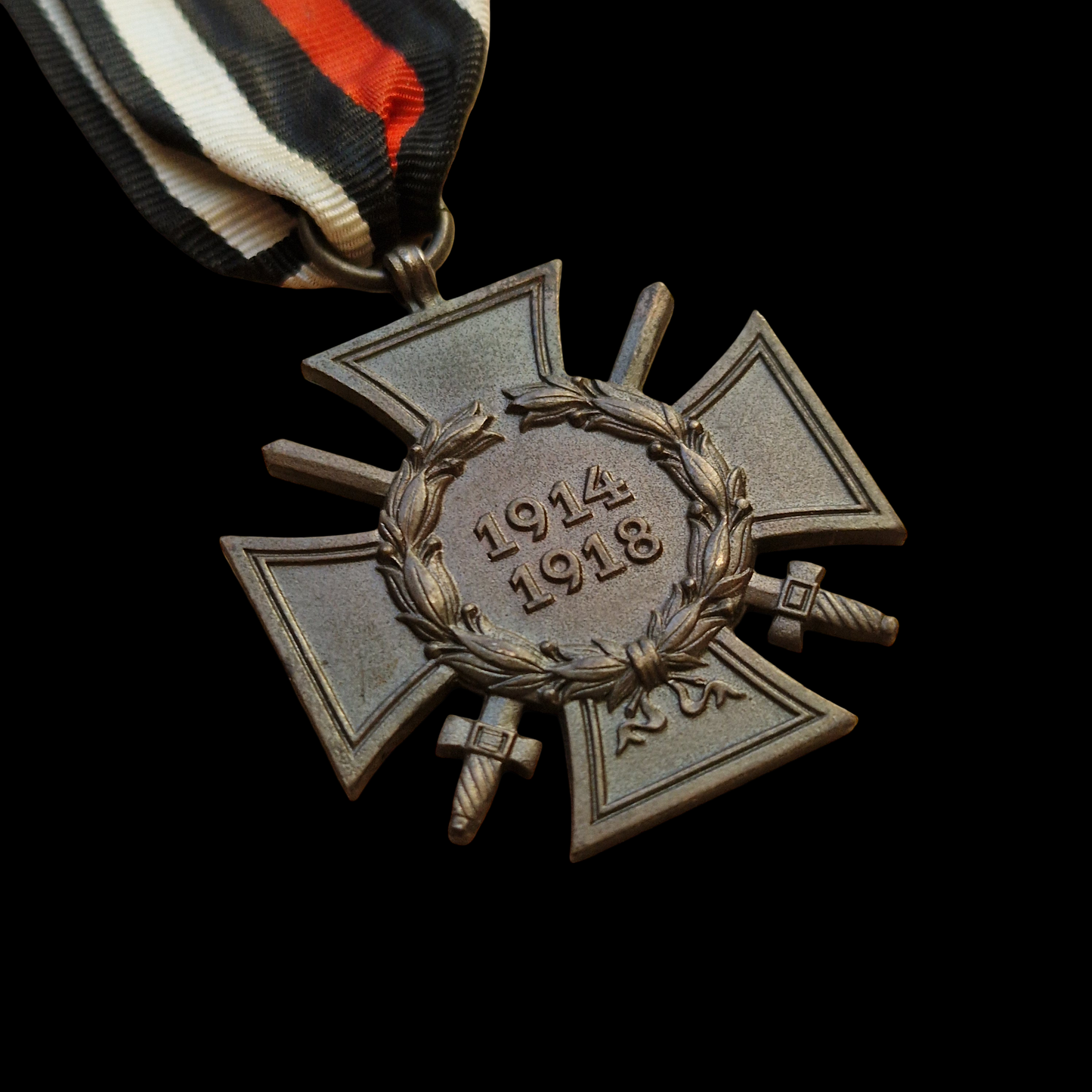
German Honour Cross of the World War 1914–1918
(Honour Cross with Swords – Front-Line Veterans)
The Honour Cross of the World War 1914–1918, commonly known as the Hindenburg Cross, was instituted on 13 July 1934 to commemorate service by German veterans of the First World War. It represents the first official state service decoration issued to surviving soldiers of Imperial Germany who had taken part in the conflict.
This example is the combatant’s version, distinguished by the presence of crossed swords between the arms of the cross, and was awarded exclusively to front-line veterans who had served under fire. The award was presented in bronze and features a laurel wreath encircling the central medallion bearing the dates 1914 – 1918, symbolising victory and honourable service. The reverse is plain, typically bearing only a maker’s mark where applicable.
The cross is suspended from its correct ribbon of black, white, and red, the national colours of Imperial Germany, arranged in the standard combatant pattern. The decoration was commonly worn on formal occasions and veterans’ commemorations during the inter-war years.
The Honour Cross was issued in three distinct forms:
- With swords for front-line combatants
- Without swords for non-combatant war service
- Without swords in black finish for widows and parents of those killed
Between 1934 and 1944, over six million combatant versions were awarded, reflecting the vast number of surviving First World War veterans. Each award was originally accompanied by a named certificate (Urkunde), specifying the class of cross issued.
Today, the Honour Cross with Swords remains an important and recognisable First World War service award, marking the contribution of front-line soldiers and forming a key component of German Great War medal collections.
AJMS Medals