


First World War British Silver War Badge - Private Percy Hawkins, 2nd Welsh Field Ambulance, Royal Army Medical Corps
Silver War Badge - B211317
Percy Hawkins was born on 18 January 1896 in Pontycymmer, Glamorgan, the son of Richard and Margaret Hawkins. Raised in the industrial heart of South Wales, Percy grew up amid the hard realities of coalfield life. By 1911, aged only 15, he was already working as a coal miner while living with relatives in Station Street, Maesteg—typical of boys from the valleys whose working lives began early.
But even before war broke out, Percy’s path was already turning away from the pits. In 1912, at just sixteen, he enlisted as a Territorial soldier with the Welsh Field Ambulance, Royal Army Medical Corps. This pre-war enlistment is confirmed not only by the silver war badge roll but by a surviving photograph of him in RAMC uniform (Ancestry), showing both the Red Cross badge on his sleeve and the coveted Imperial Service Badge on his chest. The Imperial Service Badge was worn exclusively by Territorial soldiers who had volunteered for overseas service in the event of war—evidence that Percy had offered himself for full mobilisation long before August 1914.
When the Great War came, Percy was already trained, uniformed, and ready. He mobilised with the RAMC and later served overseas under the regimental number 366033, attached to the 2nd Welsh Field Ambulance. Their duties were among the harshest of the war: manning regimental aid posts, carrying stretchers under fire, clearing wounded from the front line, performing emergency treatment, and keeping men alive long enough to reach casualty clearing stations. The Welsh RAMC Territorials developed a strong reputation for endurance and courage, working constantly in mud, shellfire, and disease-ridden conditions.
Like many RAMC men, Percy’s health suffered from the strain. He was eventually discharged on 15 May 1919, holding the rank of Lance Corporal. His Silver War Badge (B211317) confirms that he had served overseas and that his discharge was due to sickness contracted in the line of duty.
After returning home, Percy did not go back to the mines. Instead, he built on his wartime medical experience and entered civilian healthcare. By 1921, he was working as a Male Mental Nurse at Glamorgan County Asylum, Angleton, Bridgend—one of the largest psychiatric institutions in Wales. The 1921 Census records him as head of household at 28 Cawbridge End, Bridgend, married to Lilian Maud Deere, whom he wed in 1920, with their first child born the following year.
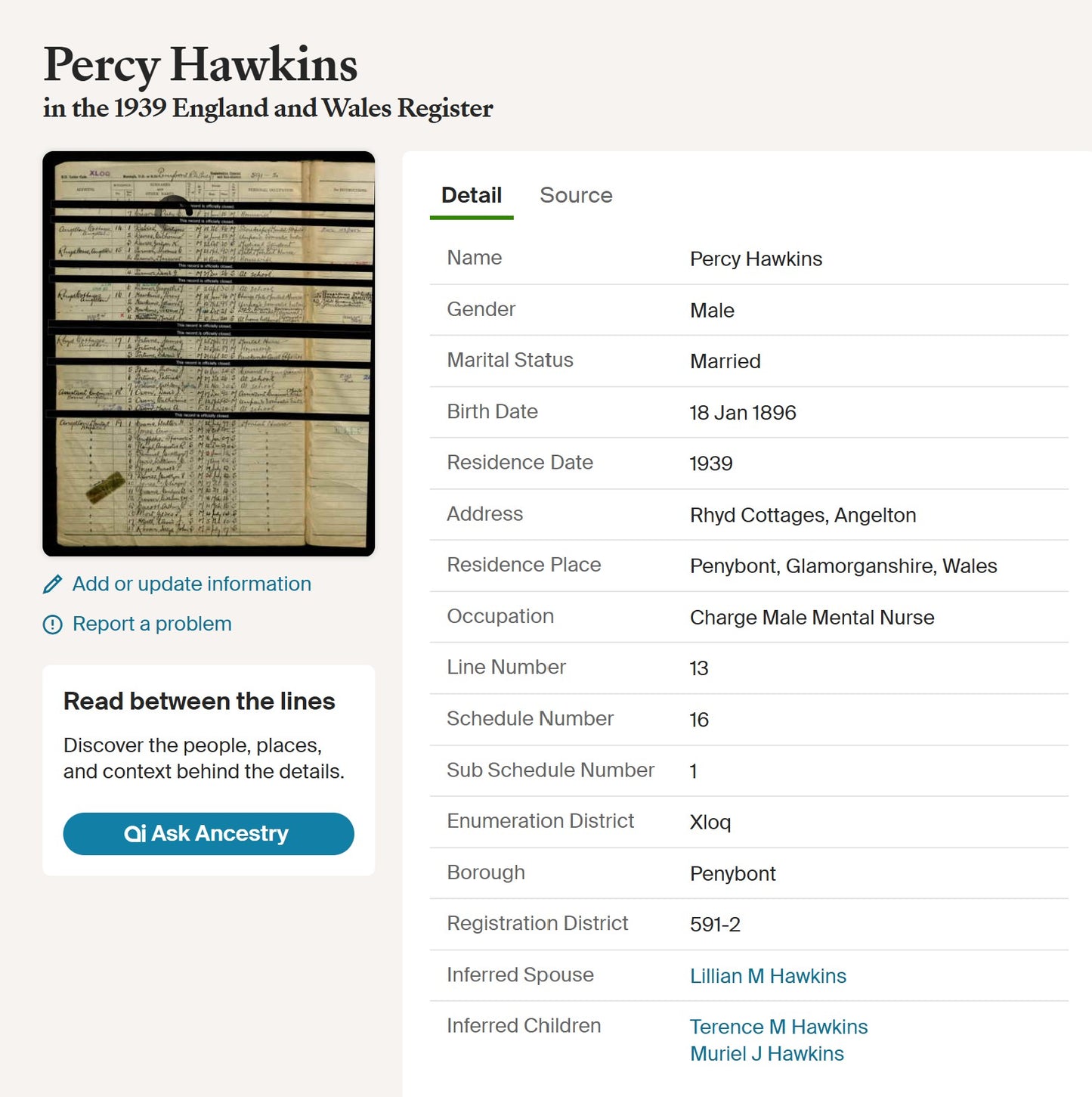
Percy continued to rise within the mental health service. By 1939, he was employed as a Charge Male Mental Nurse, living at Rhyd Cottages near the asylum grounds. His career in mental healthcare spanned decades and shows how RAMC veterans often became the backbone of institutional medical work in post-war Britain: disciplined, experienced, and able to handle difficult conditions with patience and professionalism.
Percy Hawkins died in April 1958 in Bridgend, aged 62. From coal miner to pre-war Territorial, from wartime medical service to a lifetime caring for the vulnerable in Wales’s psychiatric hospitals, his life reflects commitment, resilience, and service in both war and peace.
PLEASE NOTE: All research will be sent to the buyer via email. I am unable to provide printed copies, as I do not have access to a printer.
AJMS Medals