


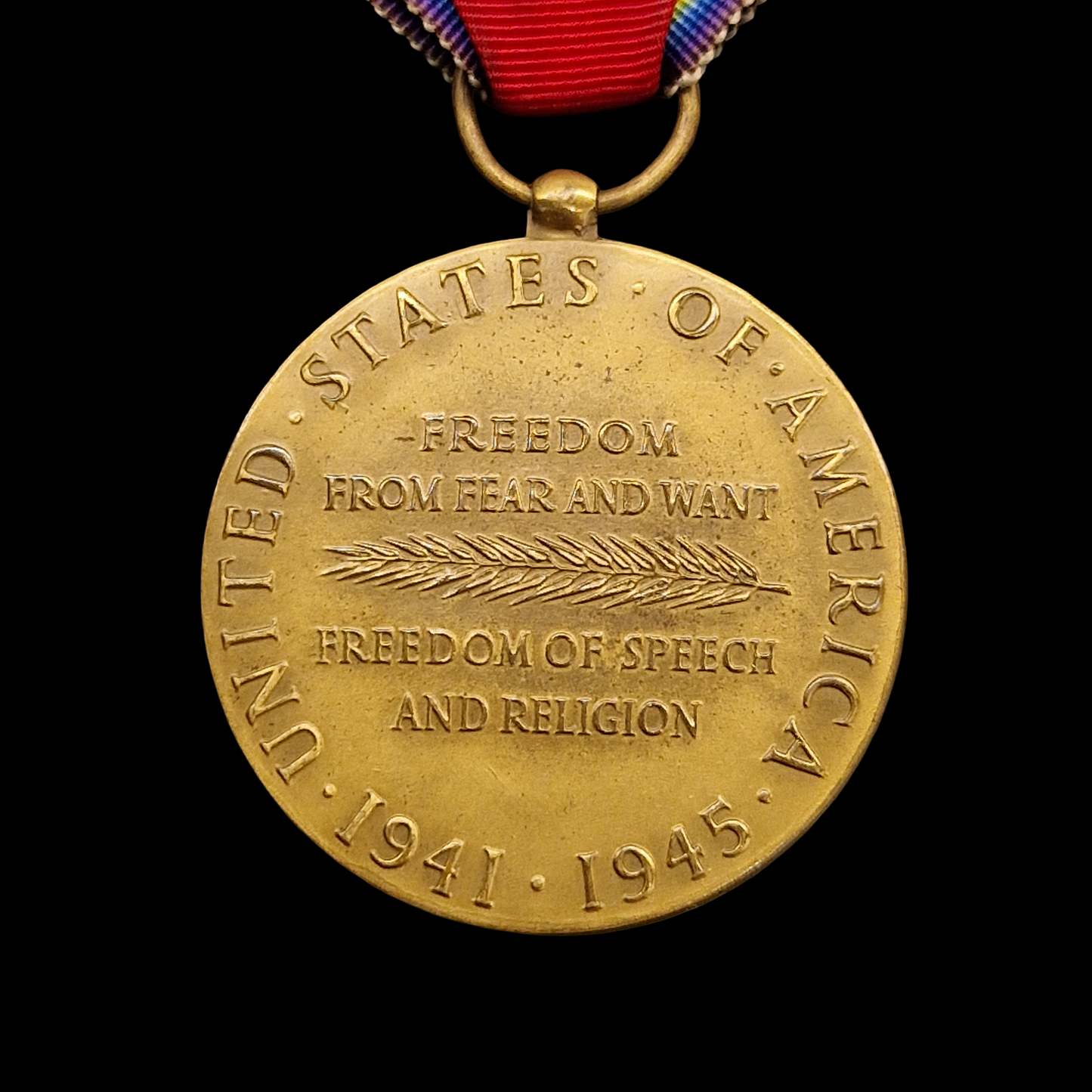
United States World War II Victory Medal
The World War II Victory Medal was instituted by an Act of Congress on 6 July 1945 and awarded by the armed services of the United States to commemorate military service during the Second World War. It was presented to all members of the United States Armed Forces who served on active duty between 7 December 1941 and 31 December 1946, with no minimum period of service required.
The medal is struck in bronze and features a powerful allegorical design. The obverse depicts the figure of Liberation, standing full-length and looking toward the dawn of a new day, with her foot resting on a defeated war god’s helmet while holding the broken halves of a sword, symbolising the end of conflict. The inscription “WORLD WAR II” appears below. The reverse bears inscriptions referencing the Four Freedoms, encircled by “UNITED STATES OF AMERICA 1941–1945”, reflecting the ideological aims of the Allied war effort.
It is suspended from its distinctive rainbow-pattern ribbon, echoing the design of the First World War Victory Medal and symbolising unity among the Allied nations. Unlike its First World War predecessor, the Second World War Victory Medal was issued without clasps, as separate campaign medals were awarded for specific theatres of operations.
Although authorised before the war officially ended, the medal was not issued in full form until after 1945, having initially been worn as a ribbon only. Owing to its broad eligibility, it became one of the most widely awarded decorations in United States military history, representing service across all branches, theatres, and roles during the conflict.
AJMS Medals