


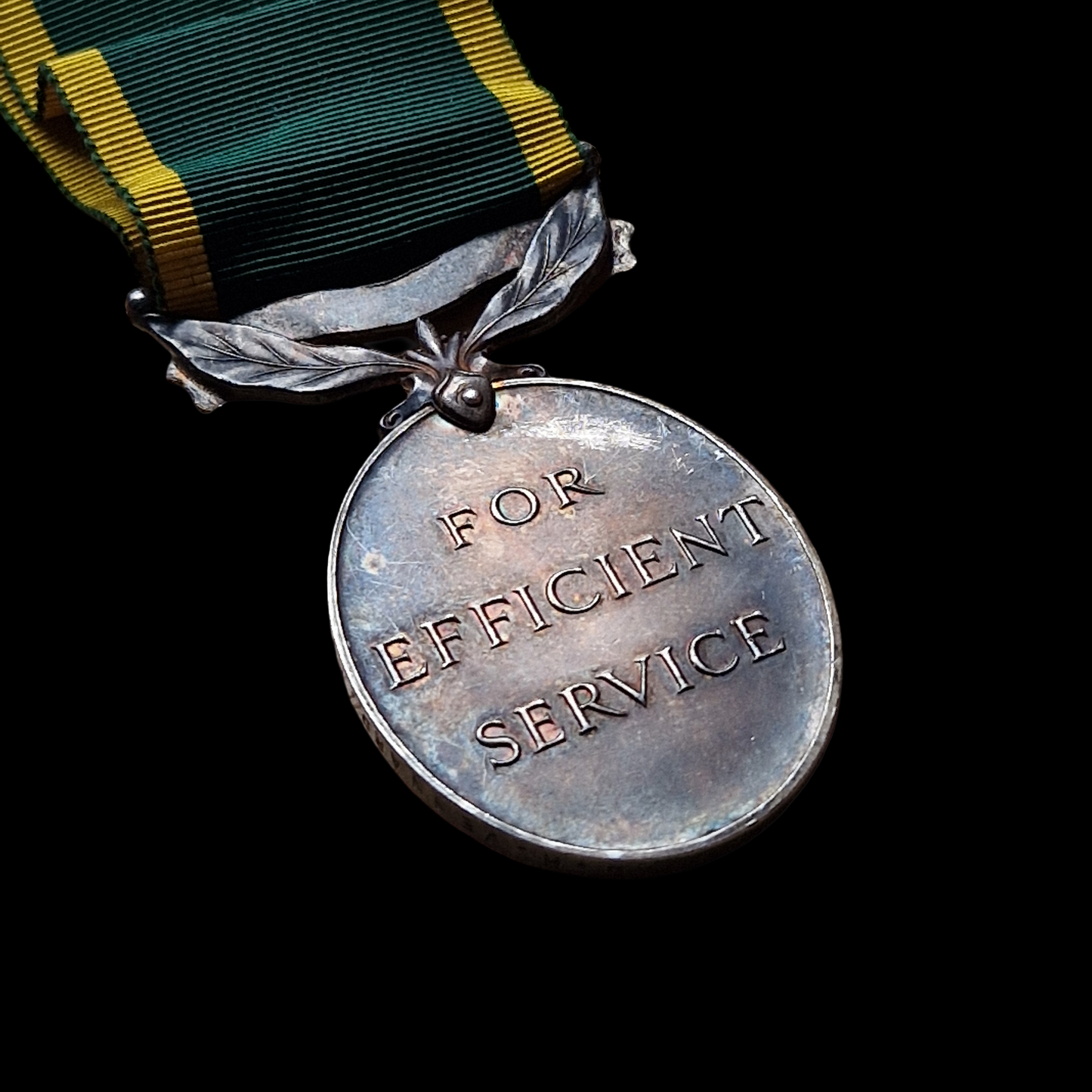
WW2 British Territorial Efficiency Medal – Bombardier John Henry Vennard, 493rd Battery, 76th Searchlight Regiment, Royal Artillery, late Queen’s Royal West Surrey Regiment
Efficiency Medal, Territorial - 6078505 BMBR. J. H. VENNARD. R.A.
John Henry Vennard was born circa 1901–1902, and first entered military service at a young age, enlisting into the Territorial Force on 20th August 1920 with the Queen’s Royal West Surrey Regiment (Territorials) at Croydon, aged 18 years and 7 months. At the time of enlistment, he was employed as a printer, and resided in Croydon, with his father recorded at 127 Old Town, Croydon.
He was allocated the service number 6078505, which he would retain throughout his later service. Enlisting for a standard four-year term, Vennard served in the Territorial ranks during the immediate post-war period, before being discharged on 18th August 1924 upon completion of his engagement.
After a period in civilian life, he re-enlisted into the Territorial Army on 28th March 1933, this time joining the 35th (1st Surrey Rifles) Anti-Aircraft Battalion, Royal Engineers (TA). This unit formed part of Britain’s expanding air defence network during the inter-war years, reflecting growing concerns over aerial warfare.
In August 1940, as part of the widespread reorganisation of Britain’s anti-aircraft defences, Vennard’s unit was transferred from the Royal Engineers to the Royal Artillery, becoming part of the Searchlight Regiments tasked with illuminating enemy aircraft during night raids. This transition marked his entry into a key component of the Anti-Aircraft Command, which played a crucial role in the defence of Britain during the Second World War, particularly throughout the Blitz.
Vennard was subsequently posted to the 493rd Battery, 76th Searchlight Regiment, Royal Artillery, a unit operating primarily in the South West of England, including defended areas such as Plymouth and surrounding coastal regions, which were frequent targets of German air attack. He remained with this battery for a considerable period, indicating stable wartime service within a fixed defensive command.
On 29th October 1944, he was transferred to the 403rd Battery, 50th Searchlight Regiment, reflecting the ongoing reorganisation of Anti-Aircraft units as the threat from the Luftwaffe diminished and resources were redeployed. Shortly thereafter, on 17th January 1945, he was again transferred, this time to the 66th Searchlight Regiment, before finally moving on 14th May 1945 to the 69th (3rd City of London) Searchlight Regiment, Royal Artillery—one of the principal London-based anti-aircraft units responsible for the capital’s defence earlier in the war.
His movements between regiments in the final year of the war are consistent with the winding down and redistribution of Anti-Aircraft Command units as Germany’s aerial offensive collapsed and the war in Europe approached its conclusion.
For his long and efficient service, spanning both inter-war and wartime periods, Vennard was awarded the Efficiency Medal (Territorial), confirmed under Army Order A.O.229 (1942), with his rank recorded as Bombardier in the Royal Artillery. This award recognised sustained, disciplined service in the Territorial Army over a qualifying period.
Vennard’s military career is characteristic of the Territorial soldier who bridged the inter-war and Second World War periods, beginning service in the aftermath of the Great War, returning to civilian life, and then rejoining in the 1930s to form part of Britain’s critical home defence network during the Second World War. His service within multiple Searchlight Regiments places him firmly within the defensive framework that protected Britain’s cities and infrastructure during sustained aerial attack.
PLEASE NOTE: All research will be sent to the buyer via email. I am unable to provide printed copies, as I do not have access to a printer.
AJMS Medals