
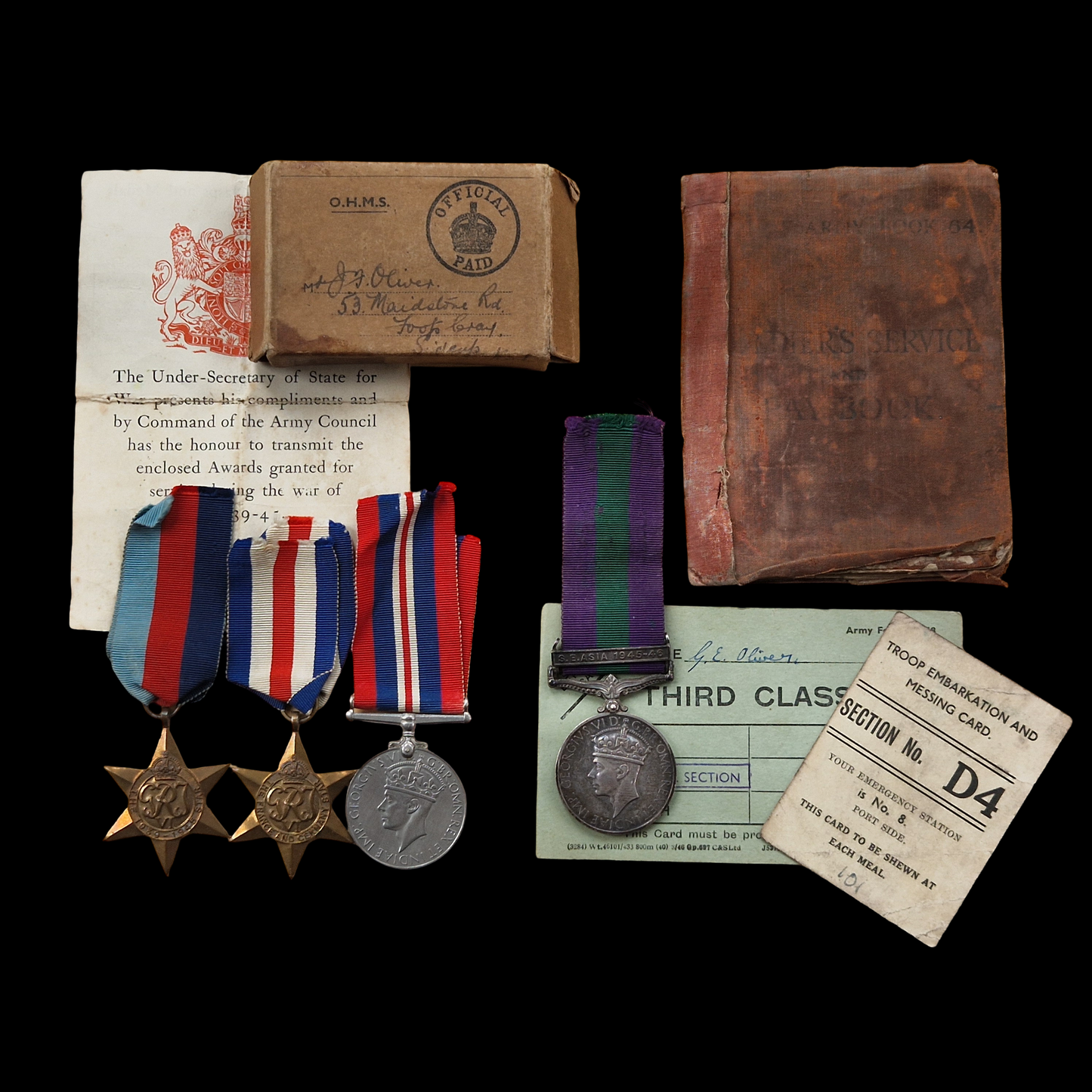
Second World War Brothers’ Medal Groups – Gunner George Edwin Oliver, Royal Artillery, 656 Air Observation Post Squadron RAF – South East Asia 1945–46; and Lance Bombardier Jack Frederick Oliver, 29th Field Regiment, Royal Artillery – North-West Europe
An interesting Second World War brothers’ group representing service in two very different theatres of operations.
George Edwin Oliver: General Service Medal 1918–62 with clasp South East Asia 1945–46, officially named 14452530 GNR. G. E. OLIVER. R.A., accompanied by his original Army Pay Book and several wartime/post-war passes and papers.
Jack Frederick Oliver: 1939–45 Star, France and Germany Star and War Medal 1939–45, unnamed as issued, together with the original card box of issue and medal entitlement slip.
14452530 Gunner George Edwin Oliver enlisted into the British Army on 19 September 1944 and initially served with the Royal Artillery, his records showing an early posting to 52nd Training Regiment. He subsequently joined the unusual 656 Air Observation Post Squadron, RAF, a formation in which Royal Artillery personnel served alongside the RAF in support of ground forces.
656 Squadron had been formed as an Air Observation Post unit, its light Auster aircraft being used principally for artillery observation, reconnaissance and liaison. Although an RAF squadron, its work was closely tied to the Royal Artillery and its Army personnel formed an integral part of the unit. During the war it had been sent to India and Burma, becoming the only AOP Squadron employed in support of the whole of the Fourteenth Army during the Burma Campaign.
George joined the Squadron during the latter stages of the conflict and remained in South-East Asia after the Japanese surrender. In September 1945, 656 Squadron moved into Malaya, with personnel landing around Morib and Port Dickson as British forces returned to territories which had been under Japanese occupation since 1942. The Squadron was then employed on reconnaissance, communications, photographic work and other duties required by the British Military Administration.
The Japanese surrender did not bring an immediate end to active operations in the region. Elements of 656 Squadron were subsequently sent to Java and Sumatra, where fighting had broken out between Indonesian nationalist forces and Allied troops attempting to restore order and facilitate the return of Dutch authority. A Flight, for example, was sent to the Surabaya area in November 1945 for Air Observation Post duties in support of the forces on the ground, operating in conditions in which the airfields and aircraft themselves came under hostile fire.
George's individual documentation does not identify the particular flight with which he served during each phase, so it would be unsafe to attribute any one of these actions directly to him. His medal entitlement does, however, specifically record his qualifying unit as 656 A.O.P. Squadron RAF, and it was for this post-war operational service that he received the General Service Medal with clasp South East Asia 1945–46. His records also appear to show later service with 1914 A.O.P. Flight, the surviving element of 656 Squadron after the main Squadron was disbanded in January 1947.
His brother, 14382157 Jack Frederick Oliver, had entered the Army considerably earlier, enlisting on 17 December 1942. He served with the Royal Artillery and is recorded with 29th Field Regiment, Royal Artillery, eventually holding the rank of Lance Bombardier.
Jack's medal entitlement provides the clearest surviving outline of his wartime service. He qualified for the 1939–45 Star, France and Germany Star and War Medal 1939–45, establishing service with the British Army in North-West Europe during the 1944–45 campaign. His Defence Medal was specifically struck from the application, confirming the three-award entitlement which remains together today.
He continued in service beyond the end of hostilities and was not released until 11 May 1947, after more than four years in uniform. His medals were subsequently claimed and issued in 1950, the surviving application recording his address as 53 Maidstone Road, Foots Cray, Sidcup, Kent.
PLEASE NOTE: All research will be sent to the buyer via email. I am unable to provide printed copies, as I do not have access to a printer.
Visit my website for better prices on most of my stock.
AJMS Medals