


Second World War Medal Group – Petty Officer James Clarke (DEMS Gunner), Royal Navy – Killed in Action During the Sinking of S.S. Empire Whale by U-662, 29 March 1943
1939-45 Star – unnamed as issued
Atlantic Star – unnamed as issued
War Medal – unnamed as issued
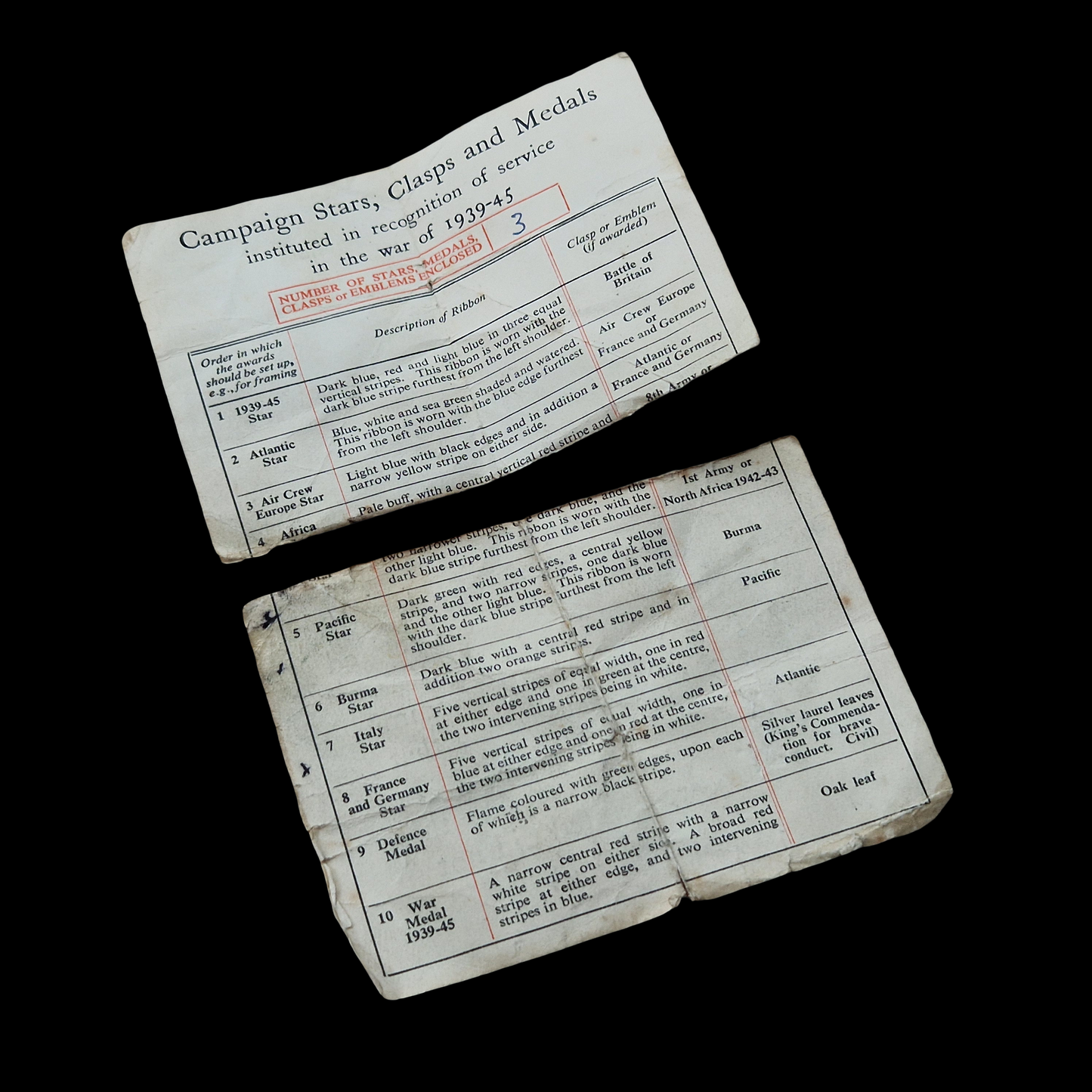
With correctly addressed box of issue and named casualty medal issue slip.
James Clarke was born on 3 August 1919 at Dewsbury, Yorkshire, the eldest son of Harry Ashton Clarke and Catherine Clarke (née Rourke), who had married the previous year. He grew up at Batley Carr alongside his younger brothers Arthur and Dennis. Following the death of his mother in 1926, his father remarried Eleanor Auty in 1930, and the family later lived at Rock Cottage, Rock House Estate, Batley Carr. James attended Batley Carr Council School and Batley Carr Parish Church, was a member of Batley Carr Working Men's Club, and before the outbreak of war was employed by Messrs Joshua Ellis & Co. of Batley Carr. His brother Arthur also served during the war, joining the Royal Air Force.
Clarke enlisted in the Royal Navy in 1940 and qualified as a Defensively Equipped Merchant Ship (DEMS) Gunner, serving as an Acting Petty Officer, service number D/JX 176085, borne on the books of HMS President III. DEMS personnel formed an essential but often overlooked branch of the Royal Navy, manning defensive armament aboard merchant vessels protecting Britain's vital Atlantic supply routes. He was posted aboard the Ministry of War Transport steamship SS Empire Whale, a 6,159-ton cargo vessel engaged in the hazardous convoy system transporting essential war materials across the Atlantic.
On the evening of 29 March 1943, while sailing in Convoy SL-126 from West Africa to the Tyne carrying almost 8,000 tons of iron ore from Pepel, Sierra Leone, Empire Whale was attacked approximately 425 miles north-west of Cape Finisterre. At 10.50 p.m., the German Type VIIC submarine U-662, commanded by Kapitänleutnant Heinz-Eberhard Müller, fired a spread of torpedoes into the convoy, sinking Empire Whale along with two other merchant ships and damaging a fourth. The attack formed part of the continuing Battle of the Atlantic, when German U-boats sought to sever Britain's maritime lifeline and inflict crippling losses upon Allied merchant shipping.
The sinking proved catastrophic. Of the fifty-seven men aboard, only ten survived. Seven merchant seamen, one DEMS gunner and two RAF personnel were rescued by HMS Spey and landed safely at Londonderry. Among the forty-seven men who perished were the ship's master, forty-one merchant crew, four DEMS gunners—including Acting Petty Officer James Clarke—and one RAF passenger. Clarke was just 23 years of age when he was lost at sea.
Initially, Clarke's parents received word that their son had been aboard a ship torpedoed on passage to England and that he was not among those rescued. Only later, in November 1943, was official confirmation received that he had been killed in action. Contemporary reports in the Batley News recalled that he had attended Batley Carr Council School and Parish Church, and noted that before joining the Navy he had worked for Joshua Ellis & Co., while his brother Arthur was serving with the Royal Air Force.
With no known grave, Acting Petty Officer James Clarke is commemorated on the Plymouth Naval Memorial, Panel 78, Column 2. He is also remembered on the Batley War Memorial, the Holy Trinity Church Lychgate at Batley Carr, and by Batley Carr Working Men's Club. His entitlement comprised the 1939–45 Star, Atlantic Star and War Medal 1939–45, and this group, complete with its original box of issue and casualty slip, commemorates a young Royal Navy DEMS gunner who gave his life protecting Britain's Atlantic convoys during the decisive phase of the Battle of the Atlantic.
PLEASE NOTE: All research will be sent to the buyer via email. I am unable to provide printed copies, as I do not have access to a printer.
AJMS Medals