


First World War Medal Trio – Seaman Donald McLeod, Royal Naval Reserve
1914-15 Star – 8281 A. D. MC LEOD. SMN. R.N.R.
British War Medal – 8281A. D. MC LEOD. SMN. R.N.R.
Victory Medal – 8281A. D. MC LEOD. SMN. R.N.R.
Donald McLeod was born on 12 March 1877 at Leith, Midlothian, and was resident on the Isle of Skye, Inverness-shire prior to the First World War. He enlisted into the Royal Naval Reserve and was mobilised for wartime service on 14 May 1915, serving as an Able Seaman. His service record confirms continuous wartime employment afloat, with service aboard a number of vessels during the conflict.
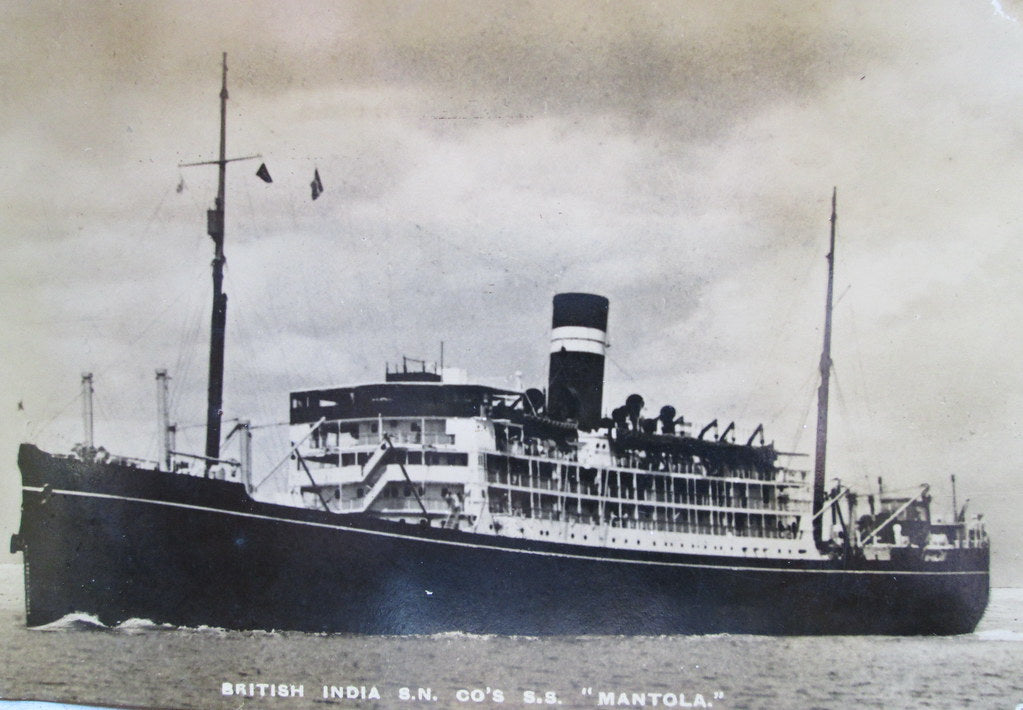
One of the most notable ships on which McLeod served was the SS Mantola, a British India Steam Navigation Company “M” class cargo liner built by Barclay, Curle & Co of Whiteinch, Glasgow, and completed in June 1916. Mantola was a large and modern vessel of 8,253 gross registered tons, powered by twin triple-expansion engines producing 4,050 ihp, giving her a service speed of almost 14 knots. Intended for the London–Bombay route, she was fitted to carry both cargo and passengers, with accommodation for 127 passengers and a crew of 165, and was defensively armed with a 4.7-inch gun.
Mantola’s wartime career was short but dramatic. On 30 October 1916, while steaming from Middlesbrough to London, she struck a mine in the North Sea off Aldeburgh, damaging her forward hold but managing to remain afloat and reach port. Following repairs, she resumed service and on 4 February 1917 sailed from London bound for Calcutta, carrying general cargo and an exceptionally valuable consignment of approximately 600,000 ounces of silver bullion.
On 8 February 1917, while in the Western Approaches, Mantola was torpedoed by the German submarine U-81, the torpedo striking abreast of the bridge and causing extensive damage, rupturing steam pipes and filling the ship with escaping steam. The order to abandon ship was given, and during the evacuation seven lascar crewmen lost their lives, either in the initial explosion or during the launching of the lifeboats. Despite the damage, Mantola remarkably remained afloat through the night. The following morning an attempt was made by HMS Laburnum to tow her, but worsening seas made this impossible, and Mantola was finally abandoned and sank on 9 February 1917 at position 49°50′16″N 13°06′12″W.
McLeod’s service record confirms that he was a survivor of the loss of SS Mantola, placing him directly at the centre of one of the more remarkable merchant shipping losses of the First World War. The wreck later gained renewed prominence when deep-sea salvage operations recovered part of her silver cargo from a depth of over 2,400 metres, further cementing Mantola’s place in maritime history.
McLeod’s wartime service with the Royal Naval Reserve qualified him for the award of the 1914–15 Star, British War Medal, and Victory Medal. He was demobilised following the end of hostilities and returned to civilian life in Culnacnoc, Skye Inverness-shire. He died on 22 June 1953 at Culnacnoc, Stenscholl.
A highly evocative Royal Naval Reserve trio, firmly attributable to the dramatic loss of SS Mantola — groups with such a clear and well-documented shipwreck survival story are scarce and increasingly hard to find.
PHOTOGRAPH – Photograph of Donald McLeod was found on Ancestry.
PLEASE NOTE: All research will be sent to the buyer via email. I am unable to provide printed copies, as I do not have access to a printer.
AJMS Medals