


British Boer War and First World War Medal Group – Sapper George Abraham Wild, the 1st (West Riding) Field Company, Royal Engineers
Queen’s South Africa Medal, 5 clasps, Cape Colony, Orange Free State, Transvaal, South Africa 1901, and South Africa 1902 – 8249 SAPPER G. A. WILD. RL. ENGRS:
1914-15 Star – 433 SPR. G. A. WILD. R.E.
British War Medal – 433 SPR. G. A. WILD. R.E.
Victory Medal – 433 SPR. G. A. WILD. R.E.
Memorial Plaque – GEORGE ABRAHAM WILD
Comes with a small colourised photograph of Sapper Wild which matches the one that appears in contemporary newspapers.
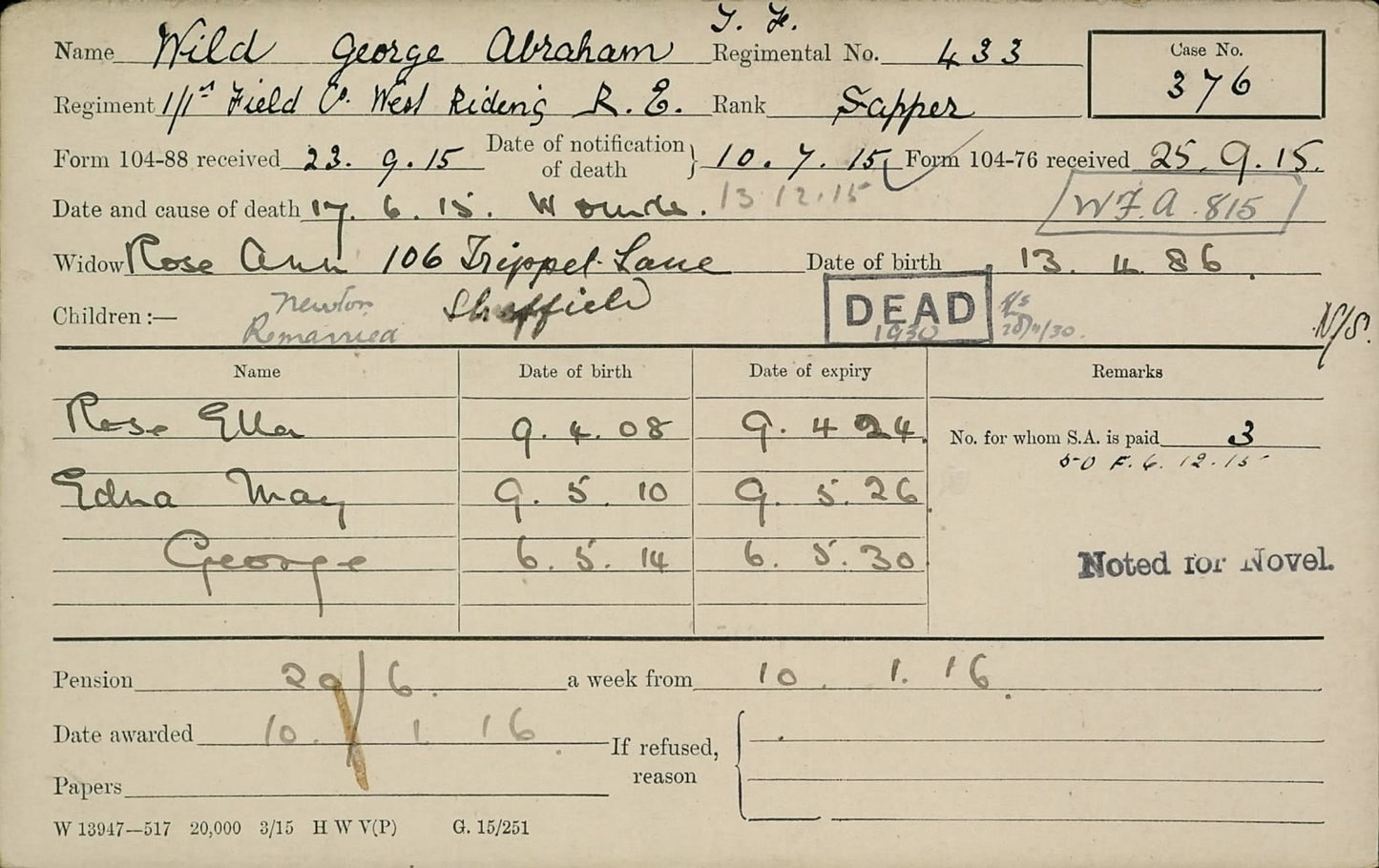
George Abraham Wild was born in April 1879 at Ecclesall Bierlow, Sheffield, West Riding of Yorkshire, the son of George William Wild and Maria Wild (née Stringer). Census records confirm that he was raised in the Sheffield area, where he spent his early life and working years. By 1911, he was married to Rose Ann Wild (née Newton), and the couple were living in Sheffield with their two young daughters, Rose Ellen and Edna May. In civilian life, Wild was employed as a circular sawyer, a skilled industrial trade closely aligned with the technical and practical demands of military engineering.
Prior to the Great War, Wild had already seen active overseas service during the South African War. He enlisted into the 1st West Yorks Royal Engineers Volunteers and served in South Africa between 1901 and 1902. His entitlement to the Queen’s South Africa Medal with clasps Cape Colony, Orange Free State, Transvaal, South Africa 1901, and South Africa 1902 confirms extended service across multiple theatres during the later stages of the campaign. A contemporary photograph published in the Sheffield Daily Telegraph shows Wild wearing his Queen’s South Africa Medal, and this image corresponds closely with the small original photograph that accompanies the medal group, providing strong and compelling visual provenance.
With the outbreak of the First World War, George Abraham Wild once again answered the call to service, rejoining the Royal Engineers as a Sapper. He served with the 1st (West Riding) Field Company, a specialist unit tasked with vital frontline engineering duties including the construction of defences, roads, and fieldworks, bridge building, and the clearance of obstacles, frequently under fire.
Wild proceeded overseas with the Gallipoli Campaign, landing with the Mediterranean Expeditionary Force during the opening phase of operations. Sapper George Abraham Wild died of wounds on 17 June 1915, aged 37, during the Gallipoli campaign. He is buried at Lancashire Landing Cemetery, Plot B.118, one of the most evocative cemeteries on the peninsula, containing the graves of men who fell during the earliest and most desperate stages of the campaign.
His Commonwealth War Graves Commission entry records him as:
“Son of G. W. and Maria Wild; husband of R. A. Newton (formerly Wild), of The Green, Thorparch, Boston Spa, Yorks. Served in the South African Campaign. Native of Sheffield.”
Wild’s death left a widow and two young daughters, and his service represents the continuity seen in many professional soldiers and skilled tradesmen who served the Empire in both the Boer War and the First World War, ultimately making the supreme sacrifice far from home.
The medals are mounted in reverse order, strongly suggesting they were arranged and worn by a family member after his death, a poignant and entirely typical practice among bereaved families.
This is a rare and historically significant Royal Engineers Boer War and Gallipoli casualty group, further enhanced by photographic identification, full medal entitlement, and strong biographical documentation.
PLEASE NOTE: All research will be sent to the buyer via email. I am unable to provide printed copies, as I do not have access to a printer.
AJMS Medals