


British Boer War Medal Group – Battery Quartermaster Sergeant Henry Hemming, Royal Artillery – M.I.D. 1901
Queen’s South Africa Medal, 4 clasps, Johannesburg; Driefontein; Paardeberg; Cape Colony – 65321 B.Q.M.SGT H. HEMMING, R.F.A.
King’s South Africa Medal, 2 clasps, South Africa 1901; South Africa 1902 – 65321 B.Q.M.SERJT: H. HEMMING. R.F.A.
1911 Coronation Medal – S:M: H. HEMMING R.F.A.
Army Long Service & Good Conduct Medal – 65321 BTY:Q.M.SJT: H. HEMMING. R.F.A.
Henry Hemming was born on 28th April 1869, and was baptised on 28th April 1869 at Hampton, Worcestershire, the son of William and Emma Hemming. He grew up at Great Hampton, Worcestershire, and is recorded there in both the 1881 and 1891 Census.
He enlisted into the Royal Artillery on 30th December 1887, aged 18 years and 7 months, declaring previous service with the 2nd Volunteer Battalion, Worcestershire Regiment. From the outset he established himself as a highly capable soldier, rising steadily through the ranks — promoted from Gunner to Sergeant between 1889 and 1895, a notably rapid progression within the regiment.
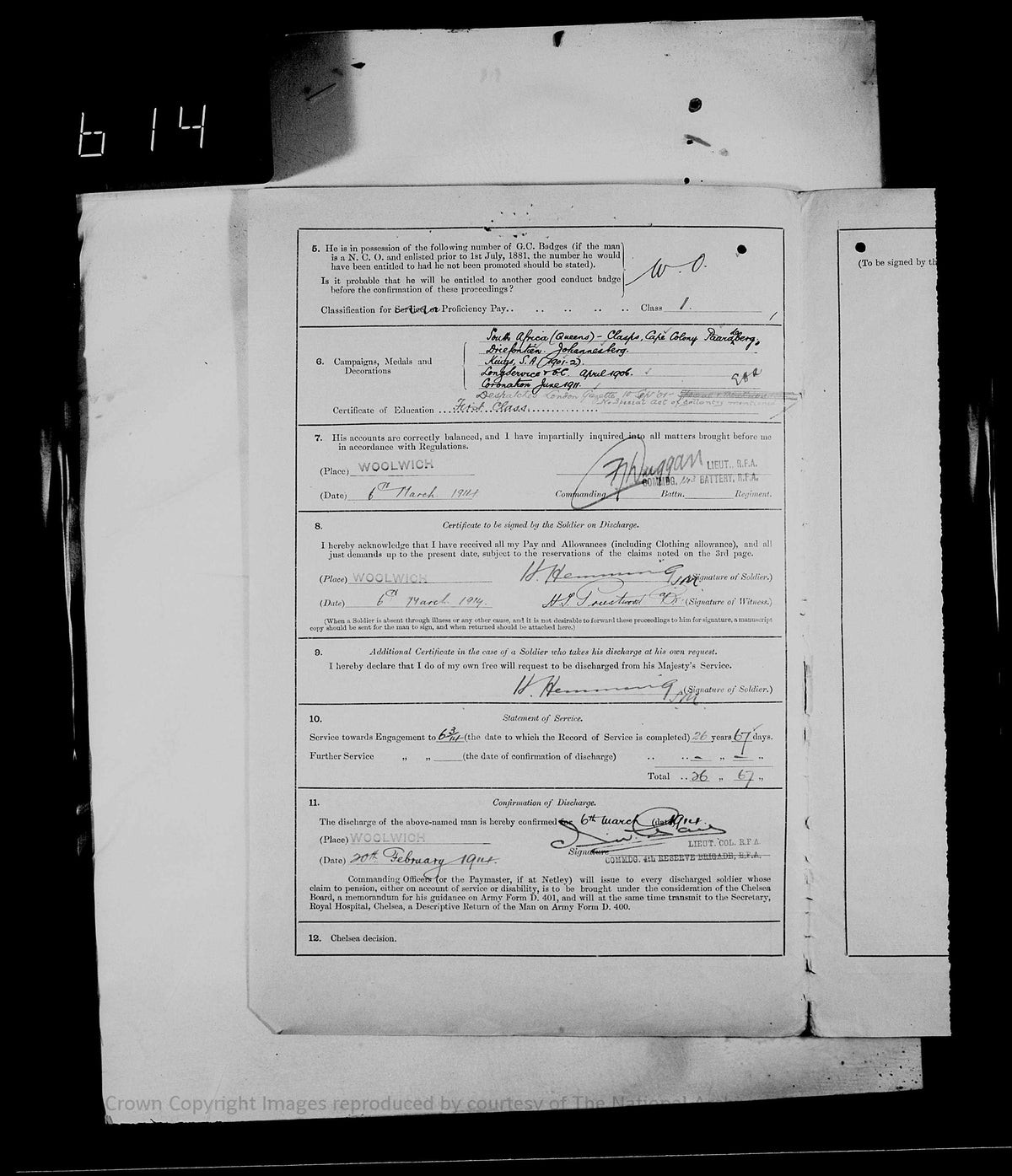
He served predominantly with the 73rd Battery, Royal Field Artillery, later the 134th Battery, Royal Field Artillery, and completed 2 years in India, nearly 3 years in South Africa, and a total of 26 years and 67 days’ service with the Colours.
During the Second Anglo-Boer War, he served in South Africa and earned the Queen’s South Africa Medal with clasps Johannesburg, Driefontein, Paardeberg and Cape Colony, confirming service in the principal operations of 1900 including the advance on Johannesburg and the fighting around Paardeberg and Driefontein. He further qualified for the King’s South Africa Medal with clasps South Africa 1901 and South Africa 1902.
Significantly, he was Mentioned in Despatches, published in the London Gazette, 10 September 1901 (page 5933), in Field Marshal Lord Roberts’ despatch of 4 September 1901 — a notable distinction for a senior NCO and strong evidence of recognised conduct and efficiency during active operations.
In 1899 he was appointed Battery Quartermaster Sergeant, and in 1906, whilst serving as BQMS with the 134th Battery, he was awarded the Army Long Service and Good Conduct Medal, confirming over 18 years of exemplary service. He was promoted to Sergeant Major (Warrant Officer) in 1909, attaining the senior non-commissioned rank within the regiment. He was later awarded the 1911 Coronation Medal, consistent with his senior standing at the time of King George V’s Coronation.
He was discharged on 6th March 1914, aged 44 years and 9 months, having completed over 26 years’ distinguished Regular Army service. He did not serve during the Great War, having left the Colours only months before its outbreak.
The 1939 Register records him residing at 11 Wilsman Road, Thurrock, Essex, described as a retired Royal Artillery War Commemoration Fund Superintending Clerk and Army pensioner, indicating continued association with military administration after retirement.
He died in 1952.
A fine and fully documented Victorian and Edwardian Royal Artillery Warrant Officer’s group, combining strong Boer War clasp entitlement, confirmed Mention in Despatches, long service award, and senior rank.
PLEASE NOTE: All research will be sent to the buyer via email. I am unable to provide printed copies, as I do not have access to a printer.
Visit my website for better prices on most of my stock.
AJMS Medals