


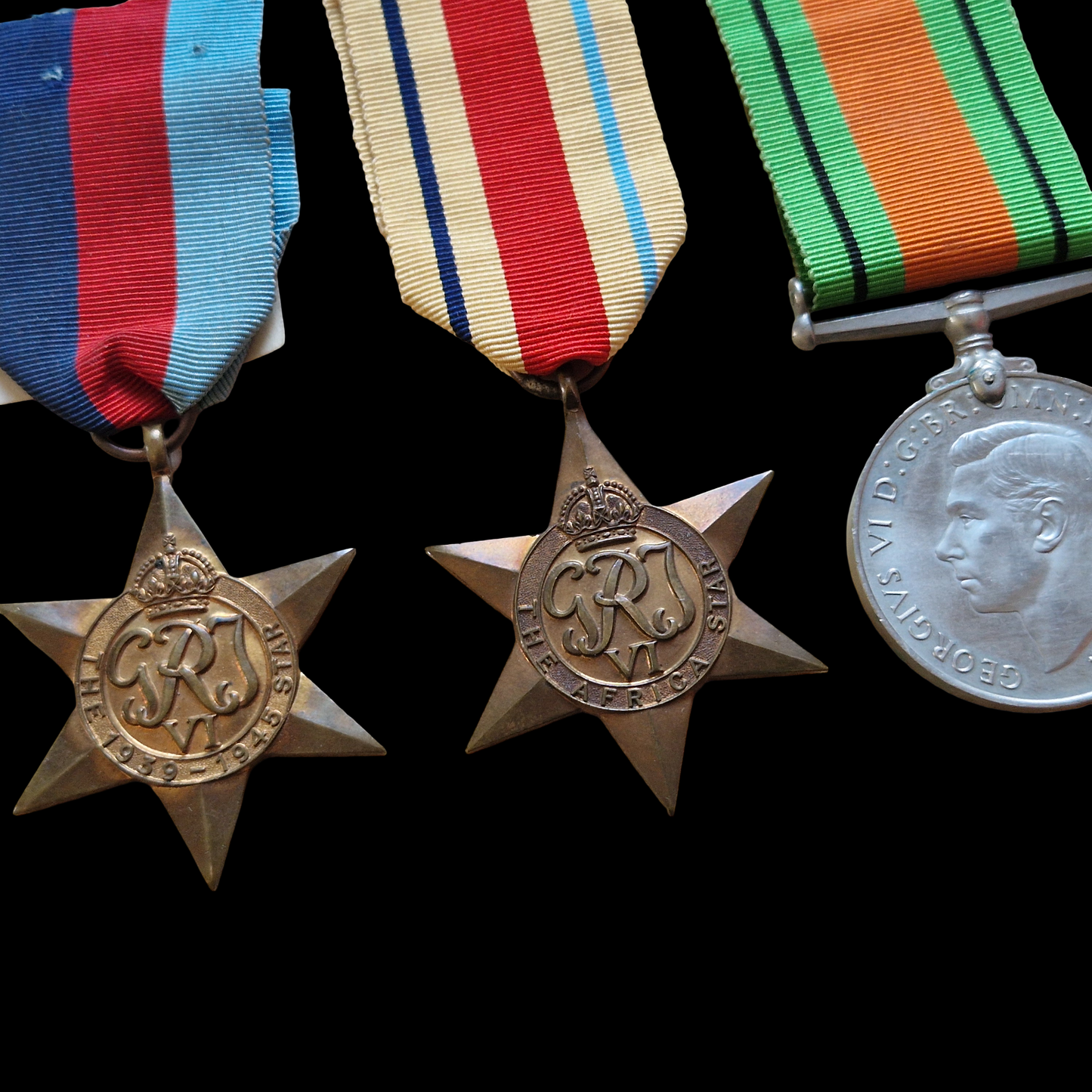
Second World War Medal Group – Major N. F. Coghill, Royal Army Medical Corps – Mentioned in Despatches
1939-45 Star – unnamed as issued
Africa Star – unnamed as issued
Defence Medal – unnamed as issued
War Medal with MiD Oak Leaf – unnamed as issued
With box of issue addressed: MAJOR N. F. COGHILL. 138, THE GROVE, EALING, LONDON, W.5.
Nelson Fuller Coghill was born on 12 October 1912 at Toxteth, Liverpool, the son of Percy De Geiger Coghill (1865–1937) and Edith Lizzie Dawson (1871–1940). He was educated at Cambridge University, graduating MA in 1934, before continuing his medical training and obtaining his MB in 1937. In 1938 he was elected Member of the Royal College of Physicians (MRCP).
Following his medical training he worked as a house surgeon at Addenbrooke’s Hospital, Cambridge, and later trained at Westminster Hospital.
At the outbreak of the Second World War, Coghill joined the Royal Army Medical Corps in December 1939. During the war he served primarily in the Middle East theatre, including service in Egypt, Cyprus, Syria and Libya. His postings included work with 27 General Hospital, 82 General Hospital and 15 (Scottish) General Hospital, treating British and Allied personnel during the North African and Middle Eastern campaigns.
His wartime service resulted in entitlement to the following awards:
- 1939–45 Star
- Africa Star
- Defence Medal
- War Medal 1939–1945
- Mentioned in Despatches (with oak leaf emblem)
During the war he married Helen Bell Longmore in Liverpool on 8 May 1940, and the couple later had two children.
Following the war Coghill embarked on a distinguished medical career. In 1946 he began work at Hammersmith Hospital, and in 1947 joined the West Middlesex Hospital, where he worked for more than thirty years as a consultant physician.
He became one of the pioneers of British gastroenterology, helping to develop one of the earliest specialist gastroenterology units in the country. Coghill was particularly known for his work on gastric biopsy techniques, an important diagnostic tool in the study of atrophic gastritis and pernicious anaemia, and published research on the subject in the British Journal of Haematology.
His influence extended beyond clinical medicine. Coghill served as President of the British Society of Gastroenterology, where he actively promoted improved staffing, research and equipment within hospital gastroenterology departments. In 1970, while serving as president of the society, he chaired the steering group which gathered the evidence that led to the creation of the Digestive Disorders Trust Fund, later known as the charity CORE – Fighting Digestive Diseases, which became a major funding body for research into gastrointestinal conditions.
Known for his strong principles and commitment to improving patient care, Coghill also helped establish occupational health services for hospital staff and encouraged junior doctors to pursue clinical research.
Later in life he cared for his wife at home after she developed multi-infarct dementia, remaining devoted to both his family and his profession.
Major Nelson Fuller Coghill died on 21 April 2002 at Ealing, London, aged 89. By the time of his death he was widely regarded as one of the founding figures of modern British gastroenterology, as well as a wartime medical officer whose service in the Middle East formed the foundation of a long and influential medical career.
Comes with printed research.
AJMS Medals