


First World War British Medal Trio - Sergeant George James Frederick Lines, 1st Bn. Queen’s Own Royal West Kent Regiment
1914-15 Star - S-9036. PTE. G. J. F. LINES. R. W. KENT. R.
British War Medal - S-9036. SJT. G. J. F. LINES. R. W. KENT. R.
Victory Medal - S-9036. SJT. G. J. F. LINES. R. W. KENT. R.
George James Frederick Lines was born on 27 October 1895 in Woolwich, Kent, the son of Frederick Louis Lines and Hannah Maria Dunthorne. Raised in a tight-knit London working-class family, he grew up between Woolwich and Charlton with several siblings, attending school locally before entering working life in his mid-teens. His mother died in June 1915 while he was already at war, one of the many private tragedies faced by soldiers serving overseas.
George enlisted in the Queen’s Own Royal West Kent Regiment on 26 February 1914, just seventeen years old, joining the 1st Battalion as a regular soldier. When war broke out in August, he was already trained and ready. He entered the Western Front early, landing in France on 7 December 1914 as a young private taking his place among the seasoned Regulars of the battalion.
The winter and spring of 1915 were brutal for the West Kents, and George experienced fierce trench fighting, poor conditions, and heavy German bombardments. On 13 July 1915, he was wounded in action, an injury serious enough for his name to appear on the official War Office casualty lists published on 20 July 1915—entitling him to wear the Wound Stripe later authorised under Army Order 204 of 1916.
Despite his youth, George’s ability and steadiness under fire quickly marked him out. He rose through the ranks with remarkable speed: Lance Corporal on 31 December 1915, Corporal on 17 August 1916, and Sergeant on 6 October 1916. These rapid promotions during active operations show that he was highly regarded by his officers and trusted to lead men in the line.
By early 1917 the battalion was holding trenches near Givenchy-les-la-Bassée, an area notorious for mine warfare, raids, and sudden, violent local attacks. It was here that Sergeant Lines was killed in action on 10 February 1917, aged just 21. He fell during what later sources describe as a trench raid in the Givenchy sector, part of the constant pressure and small-scale operations that defined the Western Front that winter. Please see below for a full account of this trench raid.
His bravery and service did not go unnoticed. George was Mentioned in Despatches by Sir Douglas Haig, the notice appearing in the London Gazette on 25 May 1917, page 5160, stating he was “deserving of special mention.” This was the highest form of recognition short of a gallantry medal and reflects courage, leadership, and distinguished conduct in the field.
George is buried at Gorre British and Indian Cemetery, plot III.C.6, not far from where he fell. The Commonwealth War Graves Commission records confirm his death in the Givenchy sector, and his headstone stands among the many Regular soldiers of the BEF who fought through the darkest years of the war.
From a seventeen-year-old recruit in 1914 to a seasoned sergeant by 1917, George James Frederick Lines’ service is a striking example of the speed with which the young men of the Old Contemptibles grew into hardened front-line leaders. Wounded, decorated, and ultimately killed in action while still only twenty-one, he represents the bravery, responsibility, and sacrifice borne by Britain’s pre-war professional soldiers. His Mention in Despatches stands as an enduring testament to his conduct under fire.
The Givenchy Trench Raid, 10 February 1917
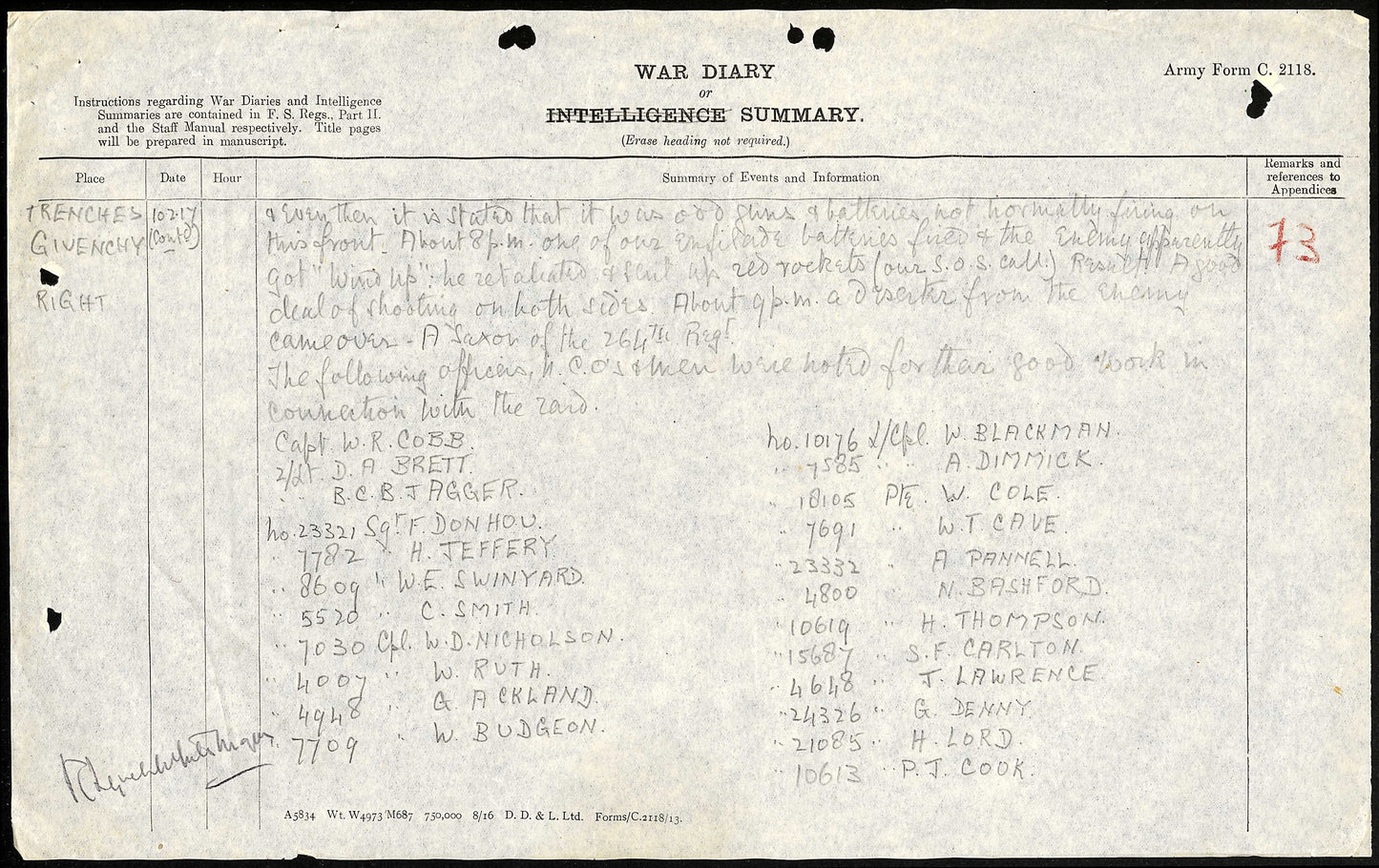
On 10 February 1917, the 1st Battalion carried out a bold daylight trench raid against the German lines in the Givenchy Right sector. Zero hour was fixed for 3.00 p.m., and the assault was entrusted to A and B Companies, under their respective commanders:
- A Company – Capt. W. R. Cobb, 2nd Lts. D. A. Brett & L. A. Harris, & Sgt. Donhou
- B Company – Capt. J. J. Scott M.C., 2nd Lts. B. C. B. Jagger & H. E. Fry, & Sgt. Lines
Each company attacked in three separate parties, advancing across a shattered foreground filled with mine craters and water-filled shell holes. In the moments before the raid began, the morning had been unnervingly quiet, suggesting the Germans might detect the impending operation. But when the battalion’s guns opened precisely at Zero, the raiders pushed forward with determination.
The artillery had cut the German wire effectively, and the assault parties crossed no man’s land with little difficulty, climbing through the craters and into the enemy’s front positions. Resistance there proved slight. Wherever Germans were encountered, they were quickly killed or captured, and the attackers pressed deeper into the trench system than originally planned. In places they moved so quickly that some parties even overtook their own creeping barrage, forcing them to advance with caution through bursts of friendly shell-fire.
Within B Company, one of the principal assault parties was led by Sgt G. J. F. Lines, whose name appears prominently in the war diary. His party entered the German trenches with “the utmost dash and keenness,” pushing aggressively into the support line and taking part in the close-quarters fighting that unfolded there. In this confused and violent struggle, amid bombing of dugouts and the clearing of trench bays, Sgt Lines was severely wounded, suffering an injury from which, the war diary records, he soon afterwards died. His loss was keenly felt within the company, which suffered the heaviest casualties of the raid.
Meanwhile, other elements continued their work: attached tunnellers destroyed enemy mine shafts; dugouts were bombed; and the raiders inflicted significant damage on the trench system. The diary estimates that around 150 Germans were killed, with additional prisoners taken, including at least one officer.
After only a short time in the trenches, the recall signal was given. B Company began to withdraw first, shortly after 3.30 p.m., followed by A Company, who had remained slightly longer under the impression they had missed the pre-arranged rocket signal. As the parties came back through the broken ground, some again passed through the tail end of the British barrage, and the diary acknowledges that a proportion of the battalion’s losses were caused by friendly fire rather than enemy action.
By the time the raiding parties were safely back in their own lines, the enemy had begun to retaliate with artillery, but the counter-battery work conducted beforehand had delayed their response long enough to spare the withdrawing troops further heavy casualties.
When the final tally was taken, the battalion had suffered:
- 11 killed
- 54 wounded
- 3 wounded and missing
- 2 missing
Among the dead was Sgt G. J. F. Lines, whose leadership and conduct during the raid were later recognised when he was Mentioned in Despatches by Sir Douglas Haig. His actions at Givenchy—leading his men into the German trenches with determination, and giving his life in the process—formed the defining moment of his wartime service.
Please note the trio is missing the MiD oak leaf.
PLEASE NOTE: All research will be sent to the buyer via email. I am unable to provide printed copies, as I do not have access to a printer.
AJMS Medals