


First World War Mercantile Marine – Fireman Edward Stanley French, Merchant Navy, died when the Lusitania was sunk in May 1915
Mercantile Marine Medal - EDWARD S. FRENCH
Edward Stanley French was born on 22 February 1878 at Kirkdale, Liverpool, Lancashire, and was baptised on 17 April 1878 at St Peter’s Church, Liverpool, the son of Edward French and Mary French. He first appears in the 1881 Census, aged 3, living with his parents at 18 Oberon Street, Kirkdale, alongside his siblings Louisa, Martha, Elizabeth, Joshua and Jessie. By the 1891 Census he is recorded as Edward S. French, aged 13, born Liverpool in 1878, residing at Bootle, West Derby Registration District, within the household of Edward P. French and Beatrice F. French, together with a large blended family of siblings and half-siblings, demonstrating a stable Liverpool working-class upbringing closely tied to the Mersey districts.
French went to sea as a young man and entered the Mercantile Marine, specialising in engine-room work. A Liverpool Crew List records him aged 21 in 1898, birthplace Liverpool, serving from the Port of Registry: Liverpool aboard the steamship Ottoman (Official Number 97824), confirming his early career in the stokehold as a professional seaman. Such work was physically demanding and essential, involving the manual firing of boilers to maintain steam pressure for propulsion.
He married Elizabeth (Lizzie) Turner and by 1911 the family were living at 13 Elizabeth Road, Orrell, Bootle. The 1911 Census records Edward as Head of Household, with his occupation clearly stated as “At Sea At Present – Marine Fireman”, while his wife Elizabeth, aged 27, remained at home with their children Charlie (10), Edward (8), Harold (3) and Robert (1). This census entry is particularly significant, as it directly confirms both his rank and role within the Mercantile Marine immediately prior to the First World War. During the was his family lived at Philip St., Liverpool.
During the war Edward Stanley French was serving as a Fireman aboard the Cunard liner RMS Lusitania, registered at Liverpool. Launched in 1906 and in service from 1907, Lusitania was one of the great Atlantic express liners of her era, famed for speed and luxury and a regular feature on the Liverpool – Queenstown – New York route. Despite the outbreak of war in August 1914, she continued in passenger service and, crucially, also carried war material, placing her firmly within the increasingly dangerous maritime war zone of the Atlantic.
On 7 May 1915, while approaching the south coast of Ireland, Lusitania was torpedoed by the German submarine U-20 at approximately 2.10 pm, around 11 miles off the Old Head of Kinsale. The ship sank in just 18 minutes, a catastrophic loss compounded by the speed of flooding and heavy list, particularly lethal for engine-room personnel working deep within the vessel. Of the 1,960 people aboard, 1,193 lost their lives, including large numbers of crew. The sinking caused worldwide outrage and became one of the defining maritime disasters of the First World War, with profound political consequences.
The torpedo struck Lusitania on the starboard side, just forward of the bridge, triggering a second internal explosion which remains debated but which dramatically accelerated flooding. The ship immediately developed a severe list, rendering many lifeboats unusable. Although designed with extensive watertight subdivision, Lusitania’s high speed and long hull worked against her once compromised, and she foundered with extreme rapidity. Engine rooms, boiler spaces and coal bunkers were amongst the first areas to flood, leaving firemen and trimmers little chance of escape.
At the time of her sinking, Lusitania was carrying 1,257 passengers and 703 crew. Among the dead were men, women and children of multiple nationalities, including 128 American citizens, making the incident a major diplomatic flashpoint. German authorities had previously issued warnings in American newspapers advising travellers against sailing aboard British vessels entering the declared war zone, yet Lusitania sailed as scheduled. Her loss became a symbol of unrestricted submarine warfare and significantly shifted public opinion against Germany, particularly in the United States.
The sinking also exposed serious shortcomings in maritime safety. Many lifeboats could not be launched due to the ship’s list and forward motion at the moment of impact. Survivors reported chaos on deck, while those below were trapped by rapidly rising water and steam. Rescue vessels from Queenstown (Cobh) recovered survivors and bodies over several days, but the majority of casualties were never recovered, leading to their commemoration on memorials rather than burial.
For members of the Mercantile Marine, the loss of Lusitania was especially significant. Merchant seamen were civilians, yet faced frontline dangers without the protections afforded to naval personnel. The sinking highlighted the risks borne by engine-room ratings in particular, whose work kept Britain’s merchant fleet moving under wartime conditions. As a result, the Lusitania disaster became one of the most powerful justifications for the later recognition of merchant seamen through awards such as the Mercantile Marine Medal, marking service carried out under direct enemy threat.
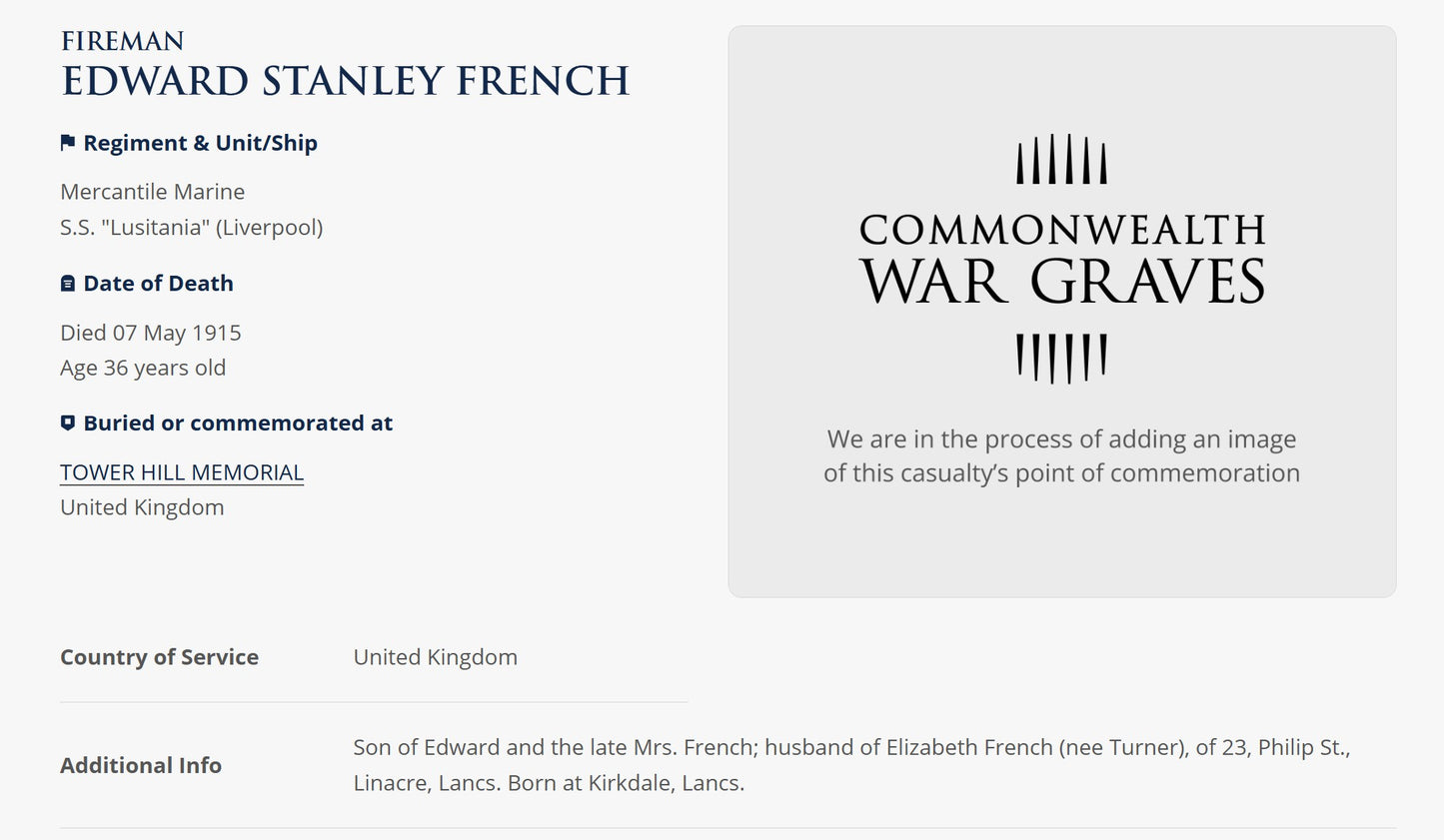
Edward Stanley French was killed at sea in the sinking of Lusitania, aged 37. Having no known grave, he is commemorated on the Tower Hill Memorial, London, which bears the names of Mercantile Marine casualties lost at sea. Commonwealth War Graves records confirm his service aboard Lusitania and name him as the husband of Elizabeth French (née Turner), giving her address as 23 Philip Street, Linacre, Lancashire, further tying the casualty record directly to the man recorded in census and civil documentation.
Important record note: The Mercantile Marine Medal records list only a single “EDWARD S. FRENCH”, and the associated medal index gives an incorrect year of birth of 1882. However, the medal is unquestionably attributable to Edward Stanley French. The wife’s name and address on the medal record correspond exactly with Elizabeth French (née Turner) at the same Philip Street, Liverpool address, and the medal record clearly states that the recipient was deceased, matching French’s confirmed death on 7 May 1915 aboard Lusitania. The incorrect birth year should therefore be regarded as a clerical error within the medal records, with all other evidence conclusively identifying the medal as his.
PLEASE NOTE: All research will be sent to the buyer via email. I am unable to provide printed copies, as I do not have access to a printer.
AJMS Medals