


Boer War Casualty QSA – Private Donald Williamson, Lovat’s Scouts – Severely Wounded at the Famous Orange River / Spitzkop Action, 20 September 1901
Queen’s South Africa Medal with clasps Cape Colony, Orange Free State, South Africa 1901, South Africa 1902 (36784 PTE D. WILLIAMSON. LOVAT'S SCOUTS.)
A highly desirable and historically important casualty Queen’s South Africa Medal awarded to Private Donald Williamson, Lovat Scouts, who was severely wounded during the famous and disastrous night attack on the Lovat Scouts’ camp at Spitzkop, near Quaagersfontein / Orange River, on 20 September 1901 — one of the best-known and bloodiest actions involving the regiment during the Boer War.
Donald Williamson was born on 20 May 1878 at Cromarty, Ross & Cromarty, Scotland, the son of Donald Williamson and Catherine Noble. The 1881 Census records the family at Torbreck Old Farm, Inverness-shire, while by 1891 they were residing at Old Inn Buildings, Urquhart and Logie Wester, where the young Williamson was recorded as a scholar. Newspaper reporting from the time of the Boer War later identified him as a blacksmith at Inshes, near Inverness, reflecting the strongly Highland and rural character of the famous corps into which he enlisted.
Williamson joined the celebrated Lovat Scouts during the latter stages of the Boer War. Raised by Lord Lovat, the Scouts rapidly gained an extraordinary reputation as expert Highland stalkers, marksmen, scouts, and irregular mounted infantry, becoming one of the most admired colonial-style corps employed by the British Army in South Africa. Drawn heavily from gamekeepers, gillies, shepherds, foresters, crofters, and Highland sportsmen, the regiment’s fieldcraft and marksmanship earned widespread admiration and directly influenced the later development of British sniper doctrine.
Williamson’s medal entitlement confirms service in the campaign with clasps for Cape Colony, Orange Free State, South Africa 1901, and South Africa 1902. However, his service became permanently associated with one of the most infamous incidents in the regiment’s history — the surprise Boer attack on the Scouts’ camp during General Christiaan de Wet and Commandant Kritzinger’s operations near the Orange River frontier.
In the early hours of 20 September 1901, Boer forces under Kritzinger launched a sudden assault on the camp of a detachment of the Lovat Scouts near Spitzkop / Quaagersfontein while attempting to force a crossing of the Orange River near the Herschel border. The attack descended into fierce close-range fighting in darkness and confusion. Contemporary newspapers described the action as a “heroic incident in the campaign,” but also as a catastrophe that sent shockwaves throughout Inverness and the Highlands.
The engagement proved devastating for the Scouts. Their commanding officer, Lieutenant-Colonel the Hon. Andrew Murray, and his adjutant, Captain the Hon. E. O. Murray, were both killed, alongside numerous officers and men. Casualties were exceptionally severe considering the relatively small number engaged. Official returns recorded:
- 11 officers and men killed
- 31 wounded
- additional men later dying of wounds
The Boers temporarily succeeded in carrying off a field gun under cover of darkness before it was later recovered during a sharp engagement in which Boer prisoners were taken. Lord Kitchener himself described the losses as “heavy,” wording that contemporary newspapers recognised as deeply ominous.
Williamson appears prominently in the official casualty returns as:
36784 Donald Williamson – Severely Wounded
The casualty lists printed in Highland newspapers reveal the enormous public reaction to the disaster. Inverness reportedly descended into scenes of anxiety and near panic as crowds gathered awaiting the publication of the names of the dead and wounded. One newspaper remarked that the news “came as a thunderbolt,” while another described it as “a press experience without precedent in Inverness.” The losses struck particularly hard because the Lovat Scouts had developed an almost legendary reputation for effectiveness combined with comparatively light casualties up to that point in the war.
The official and local casualty reports provide especially valuable context to Williamson’s medal, identifying him personally as:
“Donald Williamson was a blacksmith at Inshes, near Inverness.”
The same reports vividly emphasised the ferocity of the action, noting that the Scouts had effectively fought a hand-to-hand struggle in darkness against the attacking Boers. The casualty roll from the engagement remains one of the defining episodes in the history of the Lovat Scouts during the Boer War, making named casualty medals to identified wounded men from the action particularly desirable and sought after by collectors of Highland regiments, Boer War casualties, and Lovat Scouts material.
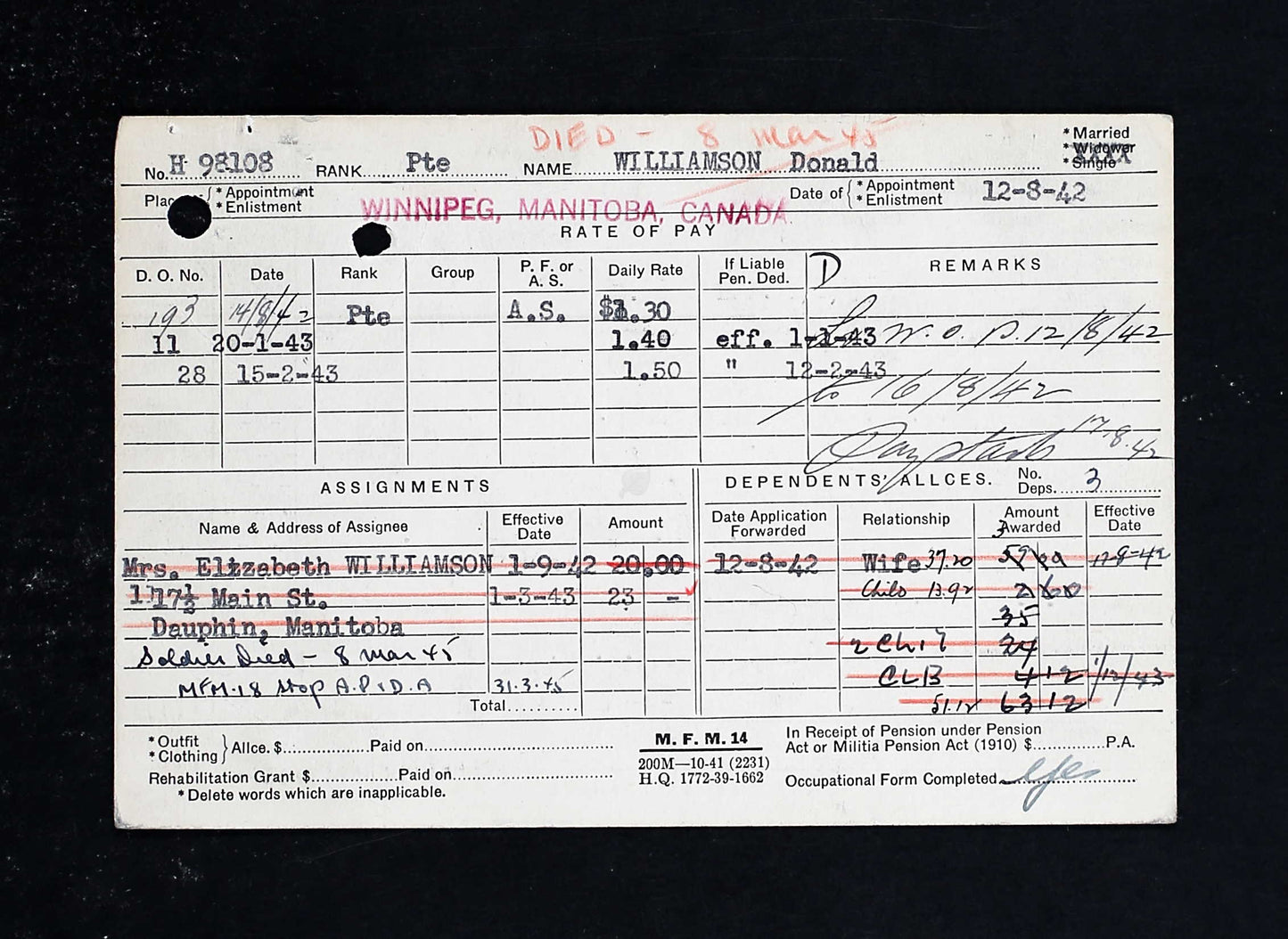
Following the Boer War, Williamson later continued his military career. During the First World War he served with the Royal Artillery, while in later life he emigrated to Canada. Remarkably, during the Second World War he again entered military service, joining the Veterans Guard of Canada — the force largely composed of older ex-servicemen employed in guard and security duties throughout Canada during the conflict.
Williamson died whilst serving with the Veterans Guard of Canada on 8 March 1945, aged 66, bringing to a close a military story spanning the Boer War, the First World War, and the Second World War. He was subsequently buried in Manitoba, Canada.
An outstanding and extremely evocative Boer War casualty medal to a member of the legendary Lovat Scouts, directly tied to one of the regiment’s most famous and costly engagements of the entire campaign.
PLEASE NOTE: All research will be sent to the buyer via email. I am unable to provide printed copies, as I do not have access to a printer.
AJMS Medals