


British Indian Mutiny Medal - Private Thomas Bates, 75th (Stirlingshire) Regiment of Foot
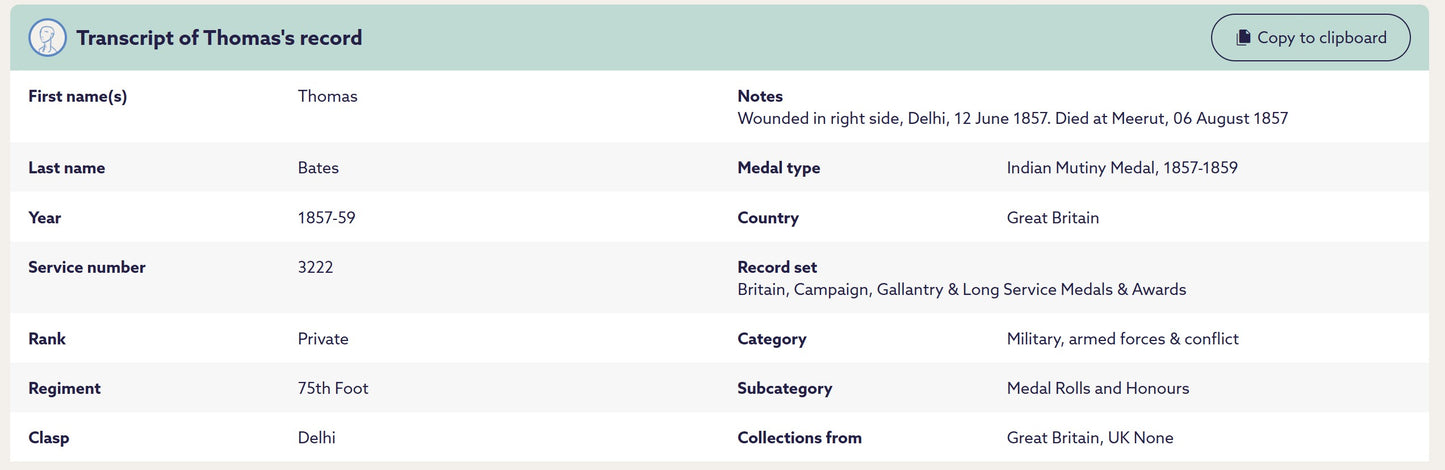
Indian Mutiny Medal, 2 clasps: Lucknow and Delhi - THOS BATES, 75TH REGT good condition, minor edge knocks (1)
Please note that it seems Private Bates is not entitled to the Lucknow clasp, however it has been added to this medal and looks to be officially done.
Private Thomas Bates served with distinction in two British infantry regiments across more than 15 years of service. He first enlisted in the 80th Regiment of Foot (Staffordshire Volunteers), serving overseas in Parramatta, New South Wales (1841) and later at Dinapore, India (1851). He saw service in the Second Burmese War (1852–53).
Bates subsequently volunteered to the 75th (Stirlingshire) Regiment on 31 January 1854, being re-numbered 3222, and served throughout the Indian Mutiny campaign. He was wounded in the right side at Delhi on 12 June 1857 during the early fighting on the ridge, and later died at Meerut on 19 July 1857, aged 33. He was buried the following day at Meerut.
- Service numbers: 1696 (80th Foot), later 3222 (75th Foot)
- Casualty record: Wounded Delhi 12 June 1857; Died Meerut 19 July 1857
- Prize roll: Entitled to Prize for Delhi (WO100/405, dated 6 August 1863)
The 75th (Stirlingshire) Regiment in the Indian Mutiny
Already stationed in India at the outbreak of the Mutiny in May 1857, the 75th were among the first regiments to march on Delhi. On 8 June 1857 they stormed the rebel entrenchments at Badli-ki-Sarai, opening the road to the city. Over the following three months they endured constant action on the Delhi Ridge, suffering heavily from heat, cholera, and near-daily engagements.
At dawn on 14 September 1857, the 75th led the First Assault Column in the storming of the Kashmir Bastion, forcing an entry into Delhi after fierce hand-to-hand fighting. The regiment’s gallantry was singled out in official reports for “the admirable gallantry of H.M. 75th Regiment in the attack and capture of the guns in the first strong position of the mutineers.”
The regiment then advanced through the Doab, fought at Bulandshahr and Agra, and later joined Sir Colin Campbell’s army for the Relief and Capture of Lucknow (1857–58), also forming the funeral party for Major-General Sir Henry Havelock at Alambagh in November 1857.
The 75th’s long Indian service ended in 1862 when the regiment returned home after 12 gruelling years in the subcontinent.
A poignant medal to a well-travelled veteran of the 80th and 75th Regiments, wounded at Delhi and dying amid one of the fiercest campaigns of the Victorian era.
PLEASE NOTE: All research will be sent to the buyer via email. I am unable to provide printed copies, as I do not have access to a printer.
AJMS Medals