


First World War 1914-15 Medal Trio - William Stewart, 'B' Coy., 2nd Bn. Gordon Highlanders
1914-15 Star - 1480. PTE. W. STEWART. GORD. HIGHRS.
British War Medal - 1480 PTE. W. STEWART. GORD. HIGHRS.
Victory Medal - 1480 PTE. W. STEWART. GORD. HIGHRS.
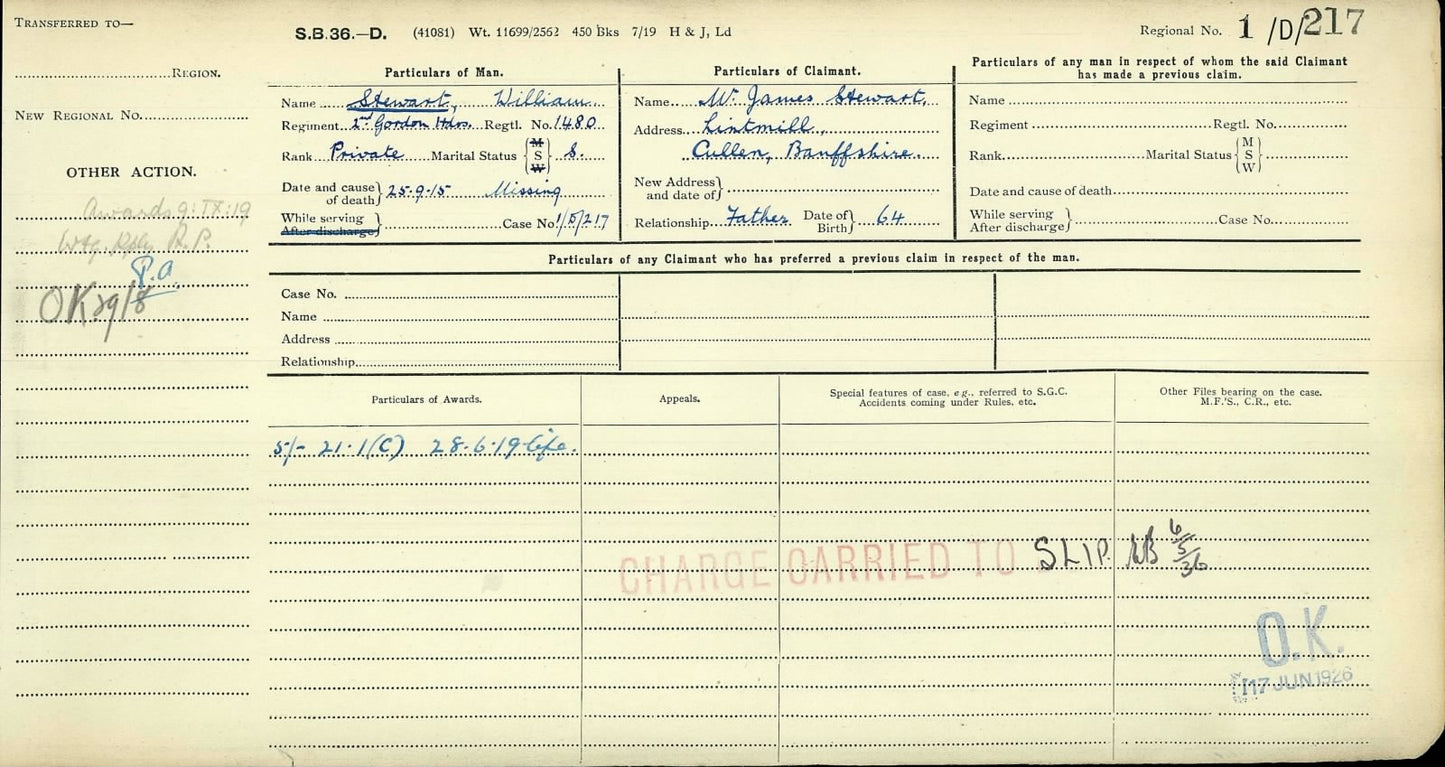
William Stewart was born and raised at Lintmill, Cullen, Banffshire, and enlisted for service at Aberdeen, joining ‘B’ Company, 2nd Battalion, Gordon Highlanders. The 2nd Gordons were a Regular Army battalion, serving as part of the 20th Brigade, 7th Division, a formation composed largely of experienced regular units recalled from overseas service at the outbreak of the Great War.
The 7th Division first saw action in Belgium in October 1914, when it was dispatched to Antwerp in a ultimately unsuccessful attempt to defend the city. Following the evacuation, the Division became heavily engaged in fighting around Ypres (Ieper), gaining a reputation as a hard-pressed but resilient formation. In March 1915, the Division fought at Neuve Chapelle, followed by further costly action at Festubert on 16th May 1915, under the command of Hubert Gough, who would later command I Corps during the Battle of Loos. Casualties at Festubert were severe, with approximately 1,300 men killed and nearly 3,000 wounded, reflecting the punishing nature of the fighting experienced by the Division during this period.
William Stewart embarked for France on 25th January 1915, joining his battalion during a time of intense and continuous trench warfare. In May 1915, he was wounded in action, during the same period in which the 7th Division suffered heavily at Festubert. Despite this, Stewart returned to duty, continuing to serve on the Western Front as preparations were made for a major British offensive later that year.
By the time of the Battle of Loos, Major General Thompson Capper, commanding the 7th Division, had returned to duty after injury and oversaw the Division’s preparations for the attack. On 25th September 1915, the opening day of the battle, the 2nd Gordon Highlanders, on the right of the 20th Brigade, advanced alongside the 8th Battalion, Devonshire Regiment. At 0630 hours precisely, both battalions went over the top, advancing through a cloud of gas and smoke released as part of the opening assault.
German artillery fire, intended to disperse the gas cloud, caused significant casualties, particularly among the 8th Devons, whose advance was delayed by wire that had been only partially cut. Despite this, the 2nd Gordons pressed forward, successfully reaching and capturing their first objective, Breslau Trench. Both battalions’ commanding officers were wounded during the advance; Lieutenant Colonel John Stansfeld, commanding the 2nd Gordons, later died of his wounds the following day and is buried at Choques Military Cemetery.
Once established in Breslau Trench, resistance was light, allowing the battalion to reorganise and continue the advance towards the Lens–La Bassée Road. Here, the supporting battalions came up, and the 20th Brigade as a whole achieved a notable measure of success. However, the failure of the flanking units left the brigade dangerously exposed. The advance ultimately halted at the point where the Vermelles–Hulluch Road crossed the Lens–La Bassée Road, leaving the forward troops in a precarious salient.
Later that night, German counter-attacks were launched, forcing the 2nd Gordon Highlanders and the rest of the brigade to withdraw from their advanced positions. During the fighting, the battalion sent a scouting party of approximately fifty men into Hulluch, where they encountered heavy wire and intense fire from a strongpoint known as Stützpunkt II. Behind them, the 2nd Battalion, Border Regiment and 9th Battalion, Devonshire Regiment occupied positions in Gun Trench and Stone Alley, attempting to consolidate the line under mounting pressure.
Artillery support was provided in part by T Battery, Royal Horse Artillery, whose dramatic gallop forward across the battlefield to a forward position was ordered by Lieutenant Colonel Henry Tudor, commander of the Division’s RHA. Despite such efforts, the cost to the Division was immense. During the Battle of Loos, the 7th Division suffered casualties of 220 officers and 5,004 other ranks, killed, wounded, or missing. While no specific casualty figure for the 2nd Gordon Highlanders is recorded in the Official History, the battalion’s losses were clearly severe, particularly among officers.
William Stewart was killed in action on 25th September 1915, during these opening assaults of the Battle of Loos. He has no known grave and is commemorated on the Loos Memorial, which bears the names of over 20,000 officers and men who fell in the Loos sector and whose graves are unknown.
Some burnt fragments of William Stewart’s service record survive and are available online, providing valuable confirmation of his service despite the widespread destruction of records during the Blitz. At the time of his enlistment, he had two brothers serving with the Seaforth Highlanders, underscoring the scale of his family’s service and sacrifice during the Great War.
PLEASE NOTE: All research will be sent to the buyer via email. I am unable to provide printed copies, as I do not have access to a printer.
AJMS Medals