


An exceptional multi-generational family medal group spanning both World Wars, comprising the medals and effects of four related servicemen of the Gardner family. The group includes an Old Contemptible of the 1st Grenadier Guards who landed in France in October 1914, a Middlesex Regiment soldier who died as a Japanese prisoner of war after the fall of Hong Kong, a Royal Artillery veteran of the North-West Europe campaign, and an 11th Hussars trooper who served in North Africa and Italy. Accompanied by a remarkable quantity of original associated material including named items, badges, service books, telegrams, wartime correspondence, silk postcards and family research, the collection forms an outstanding and deeply personal archive of British military service and sacrifice across two world wars.
Frederick Gardner – 1st Grenadier Guards, Old Contemptible, BEF 1914, Later Metropolitan Police War Service
1914 Star with Clasp – 15852 PTE F. GARDNER. 1/G. GDS.
British War Medal – 15852 PTE. F. GARDNER. G. GDS.
Victory Medal – 15852 PTE. F. GARDNER. G. GDS.
Defence Medal – P.C.420 ‘X DIV’ F. GARDNER.
Mounted as worn. Also with extensive associated material including badges, ribbon bars, named duty plate, permanent pass, and a large archive of wartime postcards and silk souvenirs sent home from France and Belgium.
Frederick Gardner was born on 12th August 1890 at Kidlington, Oxfordshire, the son of George Andrew Gardner and Henrietta Gunstone. By the time of the 1901 Census the family were living at 44 Park Street, Thame, Oxfordshire, where Frederick was recorded as the son of the household. He later married Myra Elsie Webb at Forest Hill, Oxfordshire, on 28th May 1916, and together they would have several children including George Albert Gardner, later killed during the Second World War, Frederick James Gardner, and Diana Rose Gardner. By 1921 Frederick was living at Willesden, Middlesex, employed as a Police Constable, a career reflected decades later by his award of the Second World War Defence Medal named to his police service.
Frederick enlisted into the Grenadier Guards on 26th April 1912, receiving the regimental number 15852, and served with the 1st Battalion Grenadier Guards. When the First World War broke out, the battalion formed part of the famous 20th Brigade, 7th Division, one of the first regular army formations rushed overseas to reinforce the exhausted British Expeditionary Force following the terrible early battles of 1914. Frederick landed in France on 6th October 1914, qualifying for the coveted 1914 Star with Clasp and Roses, marking him as one of the “Old Contemptibles” who served under fire during the opening months of the war before 22nd November 1914.
The 1st Grenadier Guards were thrown almost immediately into some of the hardest fighting of the early war. The battalion fought during the desperate battles around Ypres in late 1914, where the original British Expeditionary Force suffered catastrophic losses while preventing the Germans from breaking through to the Channel ports. Men like Frederick Gardner belonged to the small professional regular army that bore the brunt of this fighting, and casualty rates among the Guards battalions were extremely severe. The award of the 1914 Clasp confirms that Frederick served under enemy fire during this brutal opening campaign.
Over the following years the battalion continued to serve on the Western Front through many of the war’s major offensives. The Grenadier Guards earned a formidable reputation as elite infantry, regularly committed to difficult operations and often used in assault roles. Frederick remained in service throughout the conflict and was not discharged until 18th March 1919, indicating lengthy wartime service spanning virtually the entire war
The medal group is mounted as worn and accompanied by a substantial quantity of original associated material belonging to Frederick Gardner, transforming the medals from a standard First World War trio into a deeply personal and highly researchable family archive.
Among the items included are his named Old Contemptibles Association badge, a particularly desirable association for pre-November 1914 veterans of the BEF. Also present are his original ribbon bar, miniature ribbon bar, various Grenadier Guards badges, Guards Division insignia, a First OR Grenadier Guards Association badge, together with a named bed or duty plate engraved:
“15852 F. GARDNER.”
Also included is Frederick’s original Permanent Pass, further strengthening the provenance and personal nature of the grouping.
Particularly evocative is the very large collection of original wartime postcards sent by Frederick to his wife and children during the war. The archive reportedly contains well over thirty postcards, many being highly decorative silk embroidered First World War souvenir cards, bearing colourful patriotic and sentimental wartime designs typical of the period. Numerous cards are signed from locations such as “Somewhere in France” and “Somewhere in Belgium”, giving a direct and moving connection to Frederick’s wartime service on the Western Front. These surviving family correspondence items provide an exceptional insight into the personal side of a regular soldier’s war and greatly enhance the overall historical value of the group.
The surviving family photographs on Ancestry are another remarkable feature of the lot. One image reportedly shows Frederick wearing his medals alongside his wife, two sons and daughter, while another depicts him proudly in his Grenadier Guards uniform beside his wife. These photographs help place the medals firmly within the story of a real family whose military service spanned both world wars.
Following the First World War, Frederick entered police service and by the Second World War was serving as a police constable attached to “X” Division, qualifying for the Second World War Defence Medal, officially named:
P.C.420 ‘X DIV’ F. GARDNER
This is an especially interesting and unusual addition to the group, linking his later wartime civil defence service directly to his earlier distinguished military career as an Old Contemptible of the Grenadier Guards.
Frederick Gardner died in London on 18th August 1951, aged 61. His life represents the story of a career serviceman and public servant who served both in the trenches of the First World War and later on the Home Front during the Second World War.
Private George Albert Gardner – 1st Battalion Middlesex Regiment, Hong Kong POW, Died in Japanese Captivity 1943
1939-45 Star –6201661 Pte. G.A. GARDNER 1st MIDDX.
Pacific Star –6201661 Pte. G.A. GARDNER 1st MIDDX.
Defence Medal –6201661 Pte. G.A. GARDNER 1st MIDDX.
War Medal – 6201661 Pte. G.A. GARDNER 1st MIDDX.
Mounted as worn and privately named in the same style as his father’s medals, almost certainly worn by Frederick Gardner in memory of his son following his death in Japanese captivity.
George Albert Gardner was born at Oxford on 24th February 1916, the eldest son of Frederick Gardner, the First World War Grenadier Guards Old Contemptible, and Myra Elsie Gardner. Raised within a deeply military family, George grew up in the shadow of his father’s distinguished Great War service and would himself go on to serve during one of the most desperate campaigns of the Second World War. His parents were later living at 9 Clifford Gardens, London NW10, the address recorded as next of kin in official Japanese prisoner of war records.
George enlisted into the Middlesex Regiment (Duke of Cambridge’s Own), receiving the service number 6201661, and served with the 1st Battalion Middlesex Regiment in the Far East. The battalion formed part of the garrison defending Hong Kong in December 1941, one of the most hopeless yet fiercely fought British defensive actions of the early war. The 1st Middlesex Regiment was regarded as one of the best prepared battalions in the colony and formed a key component of the Island Brigade during the defence of Hong Kong.
The Japanese invasion began on 8th December 1941, only hours after the attack on Pearl Harbor. The defenders of Hong Kong, heavily outnumbered and lacking air or naval support, attempted to hold the colony against overwhelming Japanese forces. The fighting rapidly became fragmented and brutal, with many small units isolated and destroyed in desperate defensive actions across the island and mainland territories.
The Middlesex Regiment played a major role in the island fighting, manning defensive positions and attempting to stem repeated Japanese assaults as the colony collapsed under sustained attack. The battle ended with the surrender of Hong Kong on Christmas Day 1941, remembered ever since as “Black Christmas.” George Albert Gardner was captured by the Japanese on 25th December 1941, beginning a terrible ordeal as a Far East prisoner of war.
Official records confirm that he was initially held at Shamshuipo POW Camp, Hong Kong, before later being transferred to Japan. Japanese POW documentation records him as:
- Private George Albert Gardner
- Service Number: 6201661
- 1st Battalion, Middlesex Regiment
- Born 24th February 1916
- Place of origin: Oxford, England
- Father: Frederick
- Mother: Myra
- Captured at Hong Kong on 25th December 1941
The surviving Japanese POW card is an especially poignant piece of surviving evidence, recording his personal details, next of kin address at 9 Clifford Gardens, London NW10, and later annotations concerning his death from pneumonia while in captivity.
Like thousands of Allied prisoners captured in the Far East, George endured horrific conditions in Japanese captivity. Prisoners suffered severe malnutrition, disease, brutal treatment and appalling overcrowding. Japanese POW camps routinely ignored the Geneva Convention, while food shortages and lack of medical care led to catastrophic death rates among Allied prisoners.
At some stage during captivity George was transported aboard the notorious Lisbon Maru, one of the infamous Japanese “Hell Ships” used to move Allied prisoners in appalling conditions. The Lisbon Maru became one of the most infamous POW transports of the war, with prisoners packed into filthy holds suffering from disease, starvation and lack of sanitation. Many prisoners died either during transport or shortly afterwards from the effects of captivity and the voyage itself.
George was later transferred to Osaka POW Camp in Japan. Official records state that he died on 8th February 1943, aged just 25, from acute pneumonia whilst still a prisoner of war. One record specifically notes:
“Died from pneumonia on the Lisbon Maru.”
Another official casualty report records:
“Previously reported Prisoner of War now reported Died; previous Theatre of War: Hong Kong.”
The Japanese records further confirm that he died at approximately 3:05am from acute pneumonia, having fallen ill only days earlier.
George Albert Gardner is today buried in the beautifully maintained Yokohama War Cemetery, Japan, grave reference Brit. Sec. K.A.10. His grave marker bears the moving family inscription:
“ALWAYS IN OUR THOUGHTS UNTIL WE MEET AGAIN. DAD AND MOTHER.”
The medal group is mounted as worn and privately named in the exact same style as his father’s medals, strongly suggesting that the medals were mounted and worn by Frederick Gardner himself in memory of his son following the war. This creates an exceptionally moving connection between the two generations — the father an Old Contemptible of the First World War, the son dying in Japanese captivity during the Second.
Bombardier Frederick James Gardner – 126th (Middlesex) Light Anti-Aircraft Regiment, Royal Artillery (TA)
1939-45 Star – unnamed as issued
France & Germany Star – unnamed as issued
Defence Medal – unnamed as issued
War Medal – unnamed as issued
Efficiency Medal (Territorial) – 6206132 BDR. F. J. GARDNER. R.A.
Frederick James Gardner was born on 7th April 1919 at Headington, Oxfordshire, the second son of Frederick Gardner — the First World War Grenadier Guards veteran and Old Contemptible — and Myra Elsie Webb. He was the younger brother of Private George Albert Gardner, 1st Battalion Middlesex Regiment, who died in Japanese captivity in 1943 after the fall of Hong Kong.
The Gardner family produced two sons who served during the Second World War, each in very different theatres of war. Whilst George endured the catastrophic Far East campaign and subsequent imprisonment by the Japanese, Frederick James served in North-West Europe with the Royal Artillery after the conversion of his Territorial Army Middlesex unit into an anti-aircraft regiment.
Frederick James Gardner initially served with the Middlesex Regiment, Territorial Army, before the unit was transferred into the Royal Artillery as part of the wartime expansion and reorganisation of Britain’s air defence forces. He served as:
Bombardier Frederick James Gardner, Royal Artillery
Service Number: 6206132
His service is confirmed through the award of the Efficiency Medal (Territorial) officially named:
6206132 BDR. F. J. GARDNER. R.A.
He served with the 126th (Middlesex) Light Anti-Aircraft Regiment, Royal Artillery (TA), a unit formed in February 1942 from the 60th Searchlight Regiment. The regiment later became part of 74 Anti-Aircraft Brigade and eventually served in North-West Europe following the Normandy campaign.
The regiment’s wartime movements are particularly interesting, as it followed the Allied advance across liberated Europe during the latter stages of the war. After home defence duties in Britain — including service in Norfolk, Leicestershire, Dorset and along the Sussex coast — the regiment moved overseas in October 1944, serving under 21st Army Group in Belgium and Holland.
The unit’s recorded locations included:
- Gheel, Belgium – October 1944
- Nijmegen, Holland – November 1944
- Rotterdam, Holland – May 1945
As a Light Anti-Aircraft Regiment, 126 (Middlesex) RA would have been tasked with protecting troop concentrations, bridges, supply routes and important installations from German air attack during the Allied advance through North-West Europe. By late 1944, these units were also frequently employed in ground support roles due to the declining Luftwaffe threat, often operating dangerously close to the front line during the advance into Holland and Germany.
An especially poignant aspect of the group is its connection to his elder brother, Private George Albert Gardner, who had died whilst a prisoner of war in Japanese captivity on 8th February 1943, aged only 25. While Frederick James was serving with anti-aircraft forces preparing for the liberation of Europe, the family was simultaneously enduring the devastating loss of George in the Far East.
Genealogical records show that Frederick James later married Peggy Eileen Lewis in Somerset in December 1942, only weeks before news would eventually emerge regarding his brother’s death in captivity. He survived the war, later raising a family, and died in Brent in February 1972, aged 52.
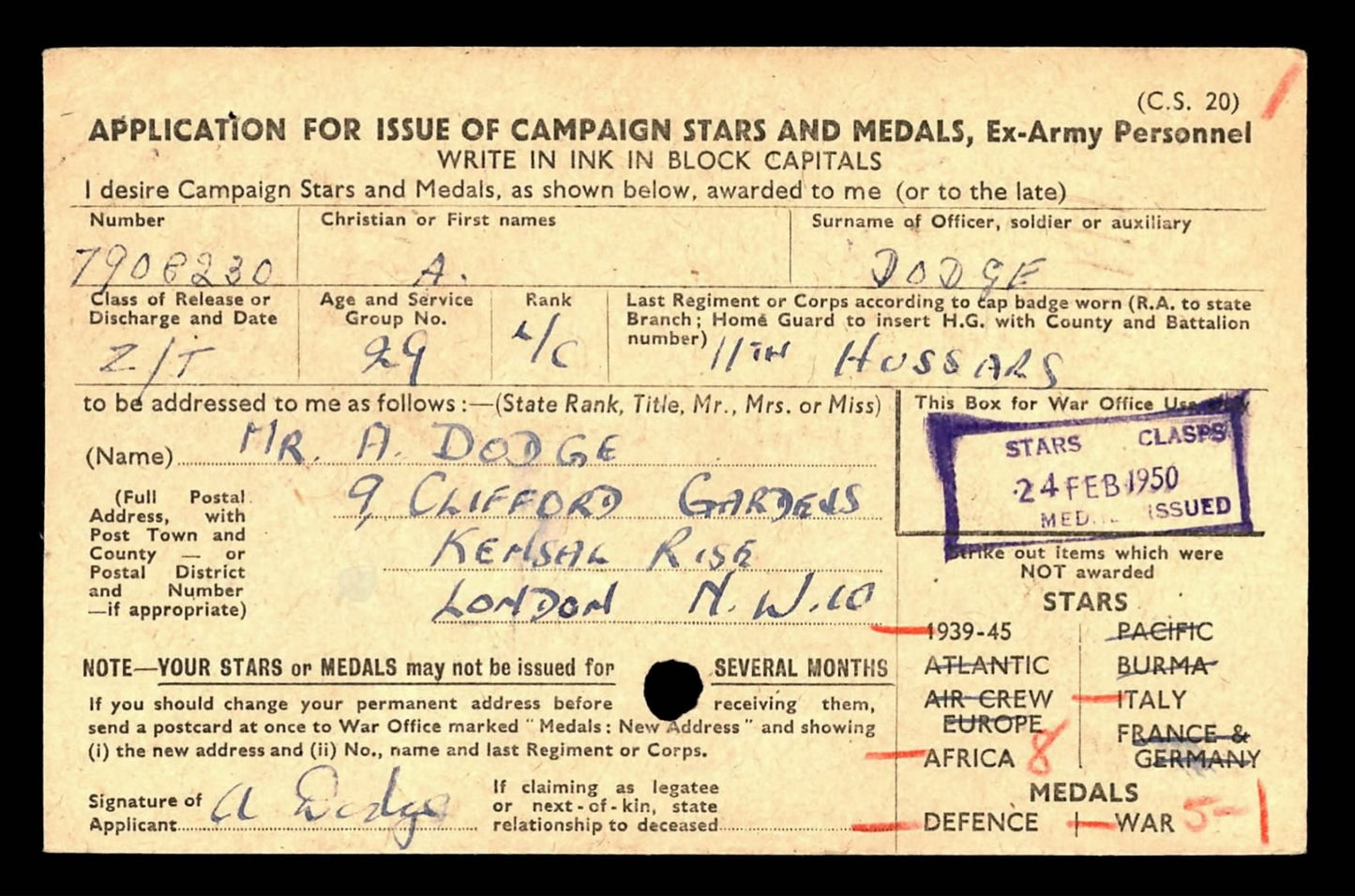
Trooper Alfred Dodge – 11th Hussars, North Africa & Italy Campaigns
1939-45 Star – unnamed as issued
Africa Star – unnamed as issued
Italy Star – unnamed as issued
Defence Medal – unnamed as issued
War Medal – unnamed as issued
Alfred Dodge was born on 23rd December 1919 at Shoreditch, London, and later served during the Second World War with the famous 11th Hussars (Prince Albert’s Own) under the service number:
7908230 Trooper Alfred Dodge, 11th Hussars
He later married Diana Rose Gardner — daughter of First World War Grenadier Guards veteran Frederick Gardner, and sister of Private George Albert Gardner, Middlesex Regiment, who died as a prisoner of war in Japanese captivity in 1943. As such, Alfred became part of an extraordinary military family whose service stretched across both world wars and several theatres of conflict.
The medal group is accompanied by his original service book, together with wartime telegrams and paperwork sent to Diana Gardner, who would later become his wife. These personal documents add considerably to the human story behind the medals, preserving direct links between Alfred and the Gardner family during wartime Britain.
The 11th Hussars was one of the British Army’s most famous cavalry regiments, renowned for its long mechanised reconnaissance tradition and for becoming the first British unit to enter action during the Second World War in September 1939. By the time Alfred Dodge served with the regiment, the 11th Hussars operated as an armoured reconnaissance formation equipped with armoured cars and light vehicles, undertaking scouting, screening and forward patrol duties in some of the most dangerous operational environments of the war.
The award of the Africa Star confirms Alfred’s service in the North African campaign, where British and Commonwealth forces fought a prolonged desert war against German and Italian forces across Libya, Egypt and Tunisia. Reconnaissance regiments such as the 11th Hussars operated far ahead of the main formations, frequently encountering enemy forces first and enduring harsh desert conditions, long-range patrols, artillery fire and sudden engagements with Axis armour.
His subsequent entitlement to the Italy Star shows continued overseas service following the North African campaign, almost certainly during the Allied invasion and advance through Italy after 1943. The Italian campaign proved one of the most difficult fought by British forces during the war, with mountainous terrain, defensive German positions and brutal weather conditions resulting in prolonged and costly fighting from Sicily northwards toward the Gothic Line.
The accompanying paperwork gives a particularly personal aspect to the group. The surviving telegrams and correspondence sent to Diana Gardner preserve the wartime relationship between Alfred and the woman he would later marry in December 1944 at Willesden, Middlesex. At the same time, Diana’s own family had already suffered the devastating wartime loss of her brother George Albert Gardner, who died in Japanese captivity aboard the Lisbon Maru system after the fall of Hong Kong.
Electoral and civil records show Alfred and Diana later living together at Kensal Rise, before later moving through north-west London districts including Kilburn and Harrow. Alfred died in King’s Lynn, Norfolk, in January 1985.
PLEASE NOTE: All research will be sent to the buyer via email. I am unable to provide printed copies, as I do not have access to a printer.
AJMS Medals