


Second World War Medal Group of 3 - Private John Lawrence Johnson
1939-45 Star - unnamed as issued
British War Medal - unnamed as issued
Territorial Efficiency Medal - 4452554 PTE. J. L. JOHNSON. D.L.I.
Comes with some original badges
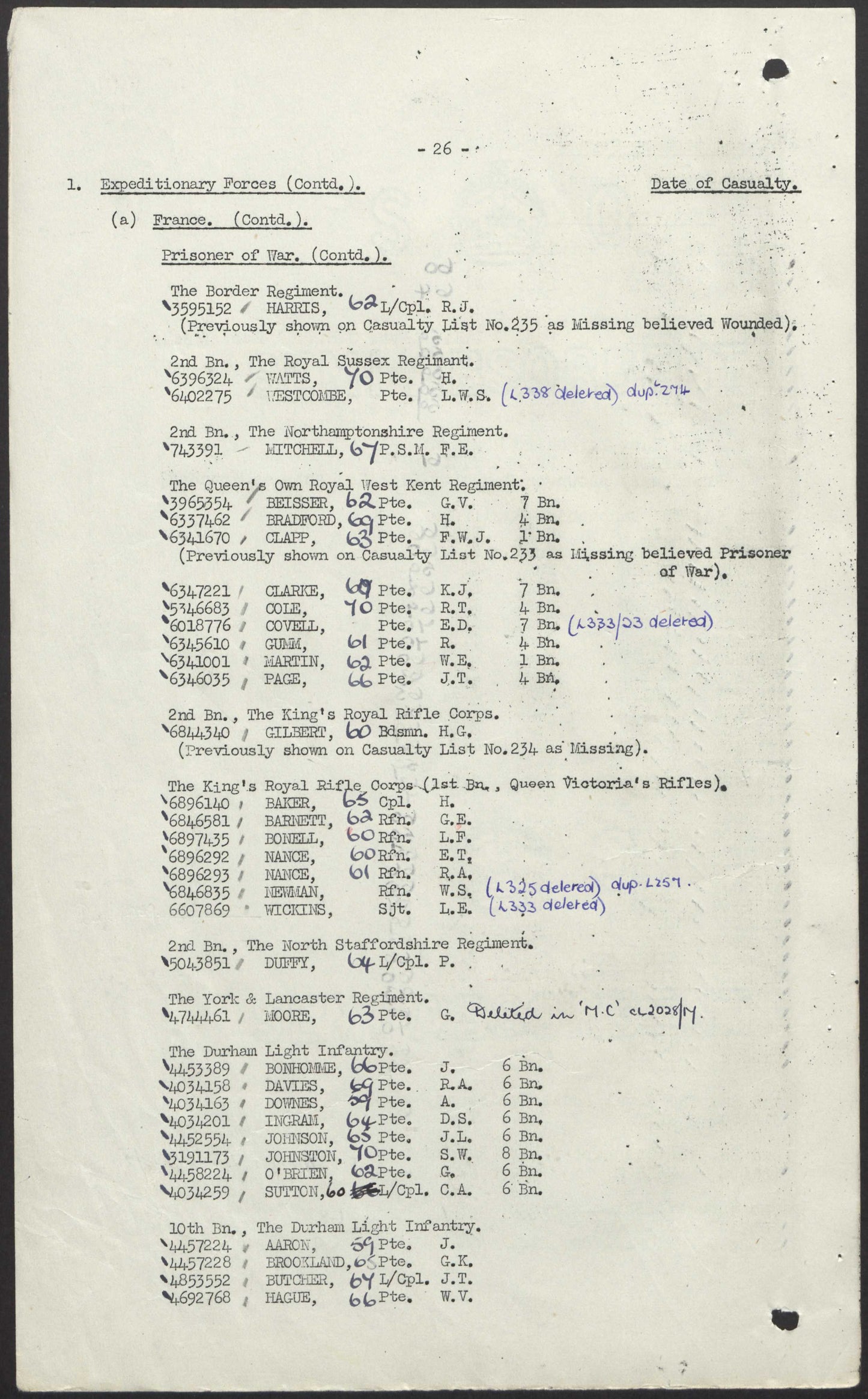
Private John Lawrence Johnson (4452554) was born on 30 January 1917 in Eldon, County Durham, and before the outbreak of war worked as a miner. He enlisted in the Durham Light Infantry on 15 June 1937, and by 1940 was serving with the 6th Battalion, one of the regiment’s Territorial units that became heavily engaged in the fighting in France during the early months of the Second World War.
During the desperate withdrawal to Dunkirk, his battalion was deployed around Arras, where British and French forces attempted to stem the German advance. It was there, on 21 May 1940, that Private Johnson was captured during the Battle of Arras. His capture was recorded by the War Office and later confirmed through German records, assigning him Prisoner of War No. 8519.
He was initially held at Stalag XXA Thorn (Toruń, Poland) before being transferred through a series of camps as the war progressed. His MI9 “General Questionnaire for British Ex-Prisoners of War”, completed after liberation, details his movements between camps and working detachments. After Thorn, he was sent to Danzig (Stalag XXA (O)), then to Stalag XXB, East Prussia, and finally to Stalag VIIIB/344 Lamsdorf (Lambinowice, Poland) — one of the largest German POW complexes.
From his own handwritten statements, Johnson recorded periods of forced labour between August 1940 and January 1945, working first on farms in Poland, then as a painter in Danzig, later on farms in East Prussia, and finally in mines in Upper Silesia. Despite the hardship, he reported that he was not wounded on capture, did not suffer serious illness, and was not subjected to interrogation or mistreatment by his captors. He also confirmed he made no escape attempts, consistent with the perilous conditions and close confinement typical of working camps under the German system.
As the Soviet forces advanced in early 1945, the prisoners from Lamsdorf and its satellite work camps were forced westward on the infamous “Long March,” a brutal trek through winter conditions that cost many lives. Johnson’s liberation was recorded by the War Office on 4 July 1945, when he was listed as “no longer a Prisoner of War”, previously reported missing in France.
After returning home to County Durham, Johnson resumed civilian life. His address at that time was 14 Cumberland Street, Coundon Grange, Bishop Auckland, and in March 1950 he applied for his wartime campaign medals, which were duly issued by the War Office. His entitlements, as confirmed on his medal application card, were the 1939–45 Star and War Medal 1939–45.
Further service records show that his long and honourable conduct was later recognised with the Territorial Efficiency Medal, awarded under Army Order 27 of 1948.
Private Johnson’s wartime experience encapsulates that of many men of the Durham Light Infantry — ordinary working-class soldiers who endured the harshest trials of captivity yet maintained their resolve and dignity through five long years behind wire. Captured in the chaos of France, held across Poland, Danzig, East Prussia and Upper Silesia, and finally freed in 1945, he returned home as one of the regiment’s many unsung survivors of captivity.
PLEASE NOTE: All research will be sent to the buyer via email. I am unable to provide printed copies, as I do not have access to a printer.
AJMS Medals