


First World War Medal Pair – Private James Chambers, Devonshire Regiment (formerly Liverpool Regiment & Royal Hampshire Regiment), Wounded in Action
British War Medal – 63798 PTE. J. CHAMBERS. DEVON. R.
Victory Medal – 63798 PTE. J. CHAMBERS. DEVON. R.
James Chambers was born in 1889 at Liverpool, Lancashire, the son of William Chambers and Martha Pears. Following the early death of his father in 1908, he remained living with his mother and siblings in Everton, Liverpool, where by 1911, aged 22, he was employed as a stone mason, a skilled manual trade.
Prior to the First World War, Chambers had already undertaken part-time military service, having served with the 6th Volunteer Battalion, King’s (Liverpool Regiment), indicating some prior military experience before his enlistment into the Regular Army during the war.
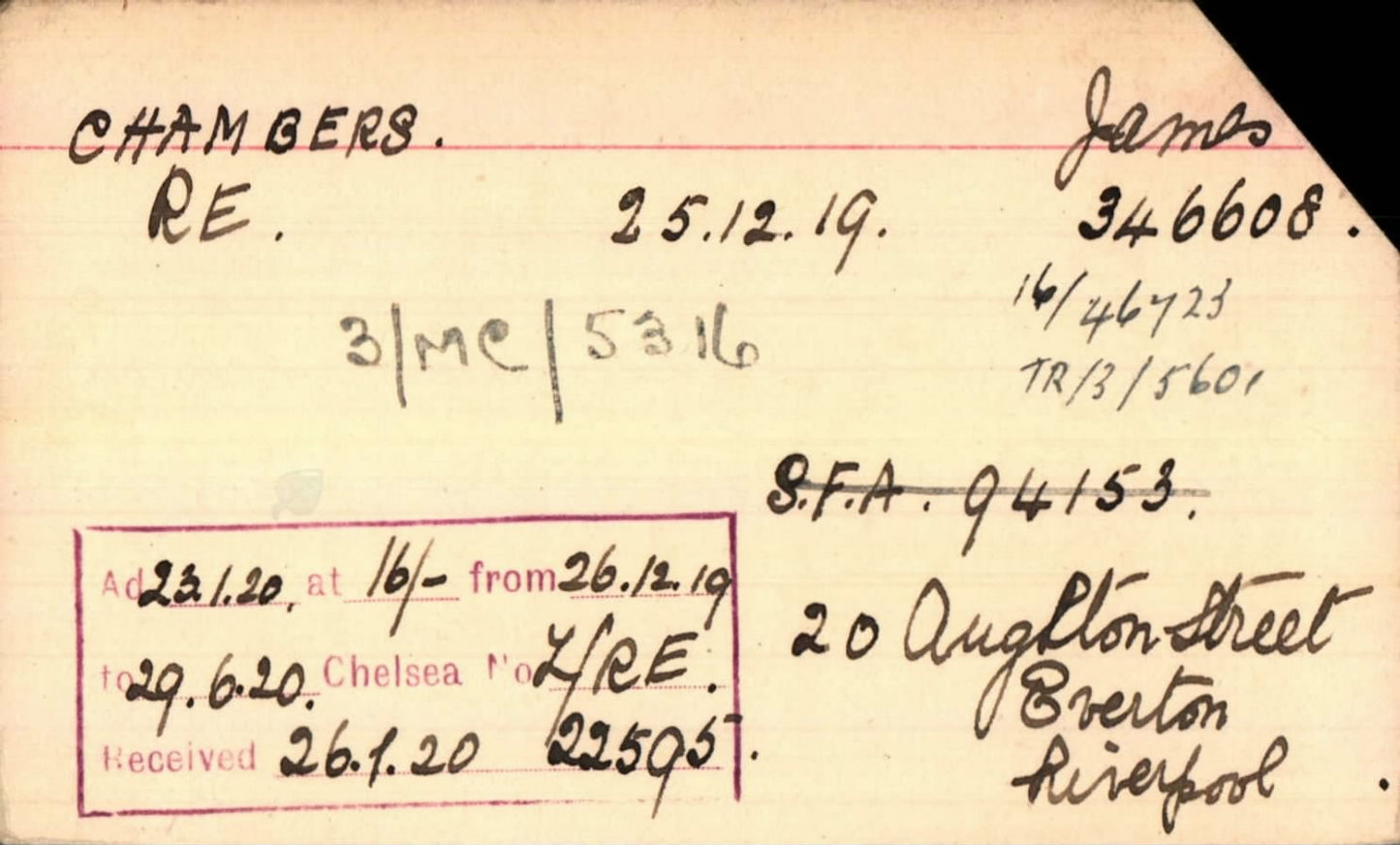
He enlisted for wartime service and initially served with the Liverpool Regiment (No. 46723), before being posted to a Training Reserve Battalion (TR/3/5601). He was later transferred to the Devonshire Regiment (No. 63798), under which number his British War Medal and Victory Medal are correctly named, confirming his qualifying overseas service.
Further service saw him transferred again, this time to the Royal Hampshire Regiment (No. 27898), reflecting the common wartime practice of moving men between regiments as reinforcements were required.
Chambers served on the Western Front, though his time with the field force appears to have been relatively limited, recorded as approximately three months, suggesting either a late deployment or interruption due to illness or injury.
He was wounded in action, suffering a gunshot wound (GSW) to the knee, a significant injury which would have impacted mobility and his ability to continue front-line service. He was subsequently admitted to hospital, with records also noting treatment for scabies and later neurasthenia (a condition commonly associated with what would now be understood as psychological trauma or exhaustion from service).
Despite these setbacks, he was returned to duty in August 1917, though his overall service record suggests he did not resume prolonged front-line service thereafter.
Chambers was eventually discharged, with records showing a post-war discharge dated 25 December 1919, and an award of a pension, with disability noted as affecting his knee, confirming lasting effects from his wartime wound. His address on discharge is given as 20 Aughton Street, Everton, Liverpool, the same area in which he had been living prior to the war.
He was entitled to the British War Medal and Victory Medal, correctly named to 63798 PTE. J. CHAMBERS. DEVON. R., reflecting his service under the Devonshire Regiment during his qualifying period overseas.
PLEASE NOTE: All research will be sent to the buyer via email. I am unable to provide printed copies, as I do not have access to a printer.
AJMS Medals