


First World War Victory Medal – Second Lieutenant Angus Murray Russell Steel, Cameronians (Scottish Rifles)
Victory Medal (copy M.I.D. oak leaf attached to the ribbon) – 2 LIEUT. A. M. R. STEEL.
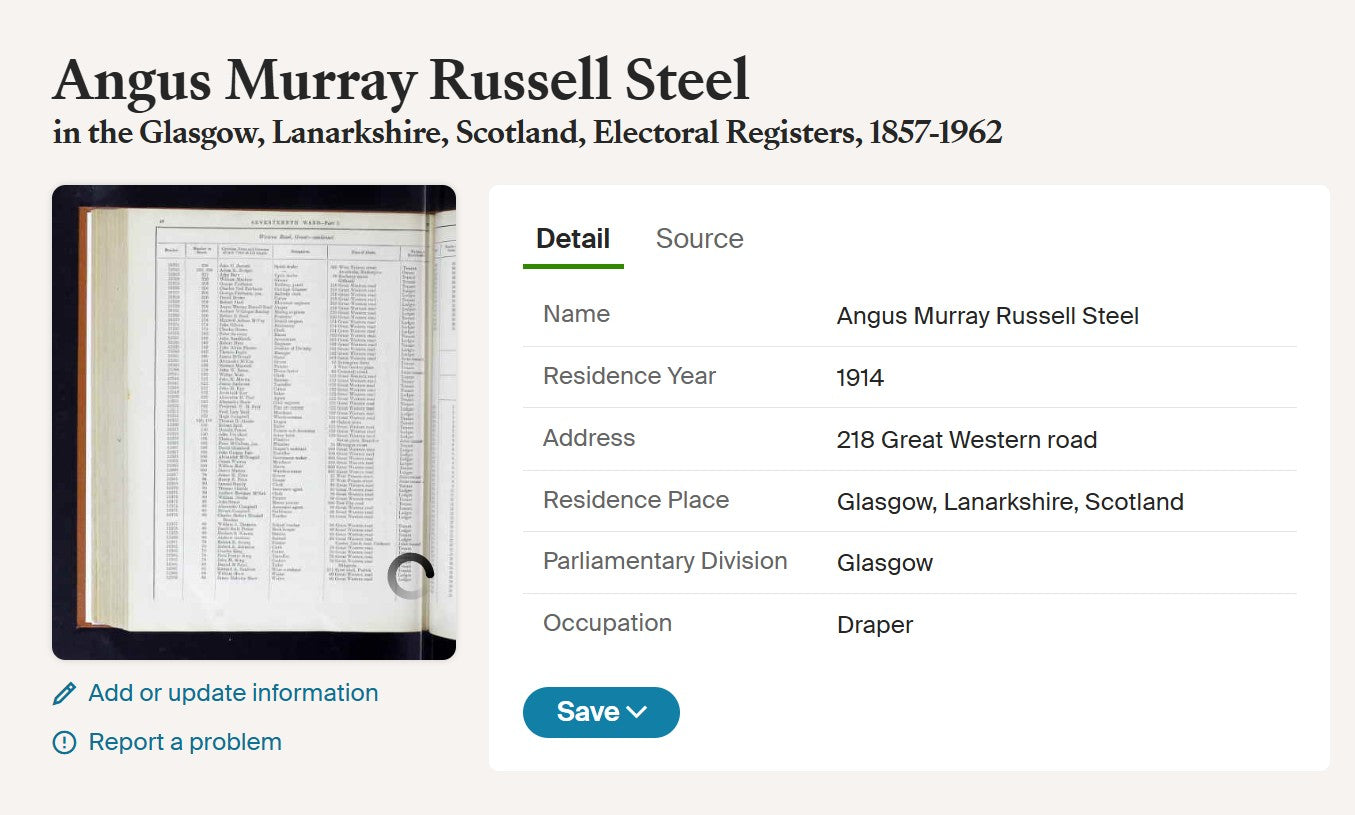
Angus Murray Russell Steel was born on 13 November 1891 at Milton, Glasgow, Lanarkshire, the son of Robert Smith Steel (1854–1924) and Mary Ann Russell Steel (1862–1936). He grew up in Glasgow, where the family resided at various addresses including Great Western Road, Kelvin, and later Maryhill, and he was one of several siblings, including Jessie Russell Steel, Jeanie Smith Steel, John Steel, and Mary Russell Steel. Prior to the war he lived in Glasgow, and he is recorded in civil and census records as residing in Lanarkshire throughout his early life.
Steel was commissioned into The Cameronians (Scottish Rifles) and held the rank of Second Lieutenant. He served with the 7th Battalion (Territorial Force), though at the time of his death he was attached to the 5th Battalion, a detail confirmed both by regimental history and casualty annotations. He was Mentioned in Despatches, as recorded on his Commonwealth War Graves Commission commemoration.
By 1918, the Cameronians were heavily engaged during the final phase of the German Spring Offensive and its aftermath in Flanders. During May and June 1918, the battalions of the regiment were operating in the difficult sector around Dickebusch, Brandhoek, Ridge Wood, and Kemmel, an area characterised by low ground, waterlogged conditions, and constant observation from higher German-held positions. The period was marked by repeated attacks, counter-attacks, gas casualties, and heavy artillery fire, even during so-called “quiet” spells.
In early May 1918, following intense German pressure, the 1st and 5/6th Battalions were involved in defensive operations stretching from south-west of Arras to north of Ypres, with responsibility for holding and restoring broken sections of the British line. The fighting around Kemmel Beck proved especially severe, with advancing troops subjected to machine-gun and artillery fire while attempting to cross swollen ground under observation. Casualties among officers were heavy, and command structures were repeatedly disrupted as senior officers were wounded, killed, or taken prisoner.
Regimental records for this period list Second Lieutenant A. M. R. Steel among the officers killed, noting his death during the operations of early June. He was killed in action on 9 June 1918, aged 26, while serving with the 1st Battalion to which he was attached. His death occurred during a phase described in the regimental history as outwardly quiet but in reality deadly, with significant losses caused by shellfire, sniping, and gas, particularly among officers exposed while carrying out reconnaissance, command, and liaison duties.
Second Lieutenant Steel is buried at Nine Elms British Cemetery, Poperinge, West Flanders, grave XIV.A.4. His headstone records his rank, full name, regiment, and date of death, and confirms his status as Mentioned in Despatches, as well as his parentage. The chosen epitaph reads:
“BLESSED ARE THOSE AMONG NATIONS WHO DARE TO BE STRONG FOR THE REST.”
He is commemorated by the Commonwealth War Graves Commission, appears in the UK Soldiers Died in the Great War records, and is listed on the Scotland National War Memorial. His death represents the loss of a young Scottish officer during the critical defensive fighting that helped halt the German advance and stabilise the front in Flanders in the summer of 1918.
PLEASE NOTE: All research will be sent to the buyer via email. I am unable to provide printed copies, as I do not have access to a printer.
AJMS Medals