


Family Group
First World War Pair – Able Seaman James Burnett Clark, Nelson Battalion, Royal Naval Division, Royal Naval Volunteer Reserve (RNVR) – K.I.A. Arras 1917
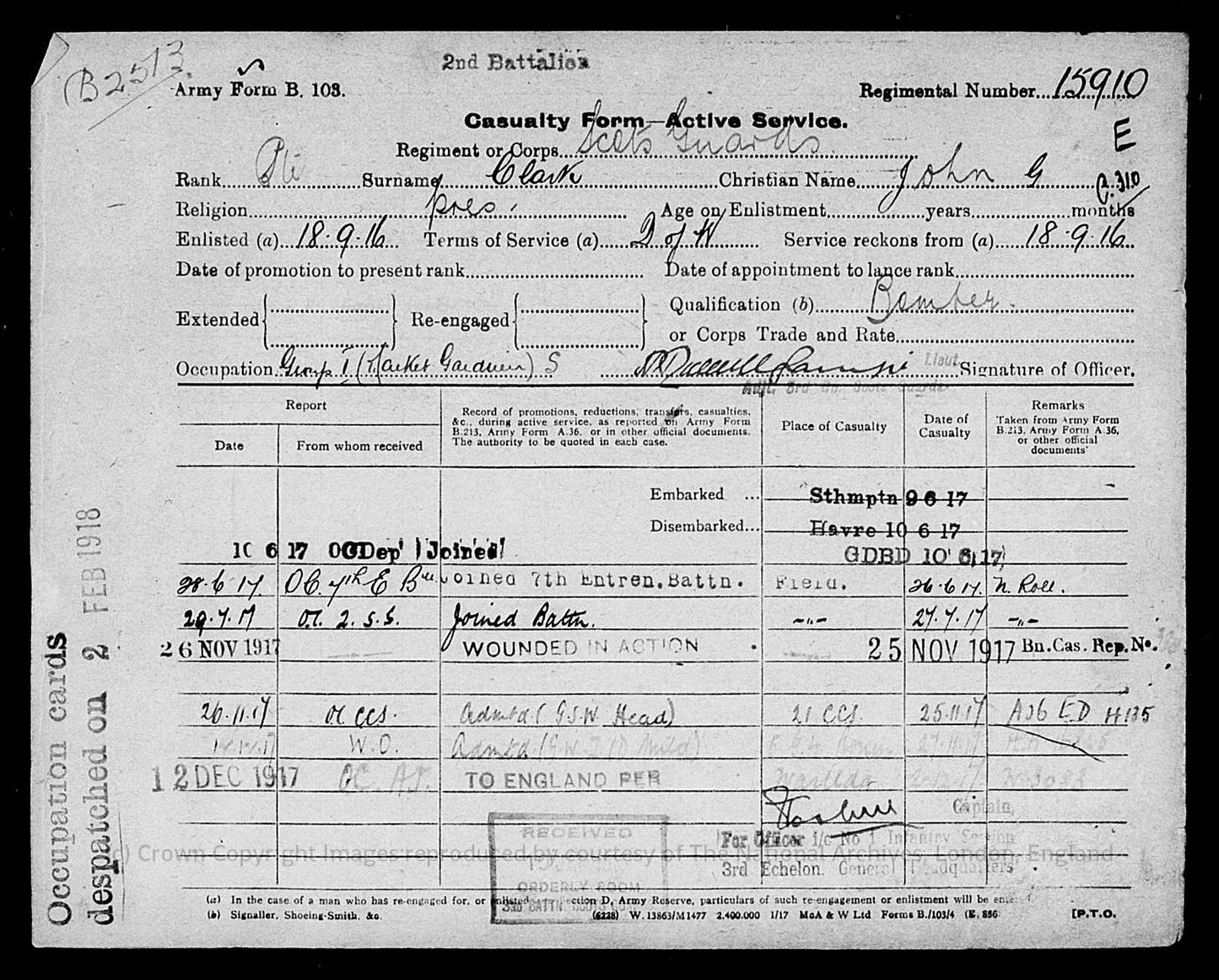
Police Long Service & Good Conduct Medal – John Gordon Clark, Police, late Scots Guards – Twice W.I.A. (1917 & 1918)
British War Medal – C.Z.7443 J. B. CLARK. A.B. R.N.V.R.
Victory Medal – C.Z.7443 J. B. CLARK. A.B. R.N.V.R.
Police LS & GC Medal – CONST. JOHN G. CLARK
(Brothers)
James Burnett Clark was born on 17th July 1893, the son of Jemima Clark, and was residing at Woods Buildings, Torphichen, Bathgate, Scotland at the time of his enlistment. He was employed in civilian life as a chauffeur, a skilled occupation requiring mechanical competence and reliability. He was described in his service record as 5 feet 10 inches in height, with fair hair, blue eyes, and fresh complexion, and was a member of the Church of Scotland. Notably, he declared that he could not swim — a detail of particular relevance for a man entering naval service.
He enlisted in the Royal Naval Volunteer Reserve (RNVR) on 30th November 1915, receiving the service number Clyde Z/7443. Initially rated as Ordinary Seaman, he was advanced to Able Seaman on 29th March 1916. Upon mobilisation he was attached to the 5th Battalion (5/2212) and was subsequently drafted through depot and reserve formations before being posted for service with the Nelson Battalion, Royal Naval Division.
Clark joined the British Expeditionary Force in the summer of 1916. Records show embarkation at Folkestone on 1st August 1916, disembarkation at Boulogne the same day, and movement to the Base Depot at Étaples on 2nd August 1916. After further administrative transfers, he formally joined the Nelson Battalion on 25th November 1916.
The Nelson Battalion formed part of the Royal Naval Division, which by 1916 was serving as infantry on the Western Front. In April 1917 the Division took part in the Battle of Arras, including the fighting around Gavrelle and the advance east of Arras.
On 24th April 1917, Able Seaman Clark was reported Wounded and Missing. Subsequent casualty lists and base reports confirmed his status remained unresolved. Missing circulars were sent to his next of kin, but no definitive information was received. On 22nd November 1917, a request was submitted for official permission to presume death. On 4th December 1917, his death was formally accepted for official purposes as Killed in Action, 24th April 1917.
He was initially buried on the battlefield in the Arras sector. In August 1920, his remains were exhumed from a battlefield grave approximately 4½ miles east-north-east of Arras and reinterred in Point-du-Jour Military Cemetery, Athies, where he now lies in Plot II, Row H, Grave 26. His next of kin, his mother Jemima Clark of Torphichen, was formally notified of both the presumption of death and the later exhumation and reburial.
James Burnett Clark was 23 years old at the time of his death. His service reflects that of a Scottish RNVR rating who trained in Britain, served as infantry with the Royal Naval Division on the Western Front, and was killed during the heavy fighting of the Arras offensive in April 1917. His records are well documented, detailing mobilisation, front-line service, casualty procedure, and post-war grave concentration.
John Gordon Clark was born circa 1897, and was residing at Woods Buildings, Torphichen, Bathgate, Scotland, the same address recorded for his brother, Able Seaman James Burnett Clark, confirming the family connection through identical next-of-kin details. He enlisted into the Scots Guards at Edinburgh in September 1916, aged 19 years, joining one of the British Army’s elite Foot Guards regiments during the height of the Great War.
Following training, Clark was posted overseas to the Western Front, where the Scots Guards were heavily engaged in major operations from 1917 onward. During the bitter fighting of 25th November 1917, in the closing stages of the Battle of Cambrai, he was Wounded in Action by gunshot wound to the head. Surviving such a wound was itself significant, particularly given the intensity of fighting and the vulnerability of infantry exposed to machine-gun and sniper fire.
Having recovered sufficiently to return to duty, he again saw active service and was subsequently Wounded in Action by gas on 14th September 1918, during the Allied advance of the Hundred Days Offensive. Gas casualties at this stage of the war often resulted from mustard gas or mixed shelling designed to disrupt attacking formations and lines of communication. That he survived both a head wound and later gas exposure reflects both resilience and the effectiveness of late-war evacuation and medical systems.
His service record confirms the same next of kin and Torphichen address as his brother James, firmly establishing the two men as siblings serving simultaneously during the war — one in the Royal Naval Division who was killed in 1917, and John continuing to serve through to the final months of the conflict.
During his military service, John Clark qualified as a “Bomber” within the Scots Guards — a specialist infantry role responsible for the use of hand grenades in trench assaults and close-quarters fighting. Bombers were selected and trained for aggressive front-line work, often operating in advance of rifle sections during raids and attacks.
Following his military service, John Clark entered the police force, embarking upon a second career in disciplined public service. He was later awarded the Police Long Service and Good Conduct Medal (Police LSGC), confirming a lengthy and exemplary record in civil law enforcement.
John Clark’s life therefore spans two phases of uniformed service — first as a Guardsman of the Scots Guards, twice wounded in action on the Western Front, and later as a long-serving police officer recognised for sustained good conduct. His survival contrasts poignantly with the fate of his brother James, killed at Arras in 1917, making this a significant and emotive two-brother Great War family group.
PLEASE NOTE: All research will be sent to the buyer via email. I am unable to provide printed copies, as I do not have access to a printer.
Visit my website for better prices on most of my stock.
AJMS Medals