


First World War Medal Trio – Private Harry Percy Taylor, Border Regiment
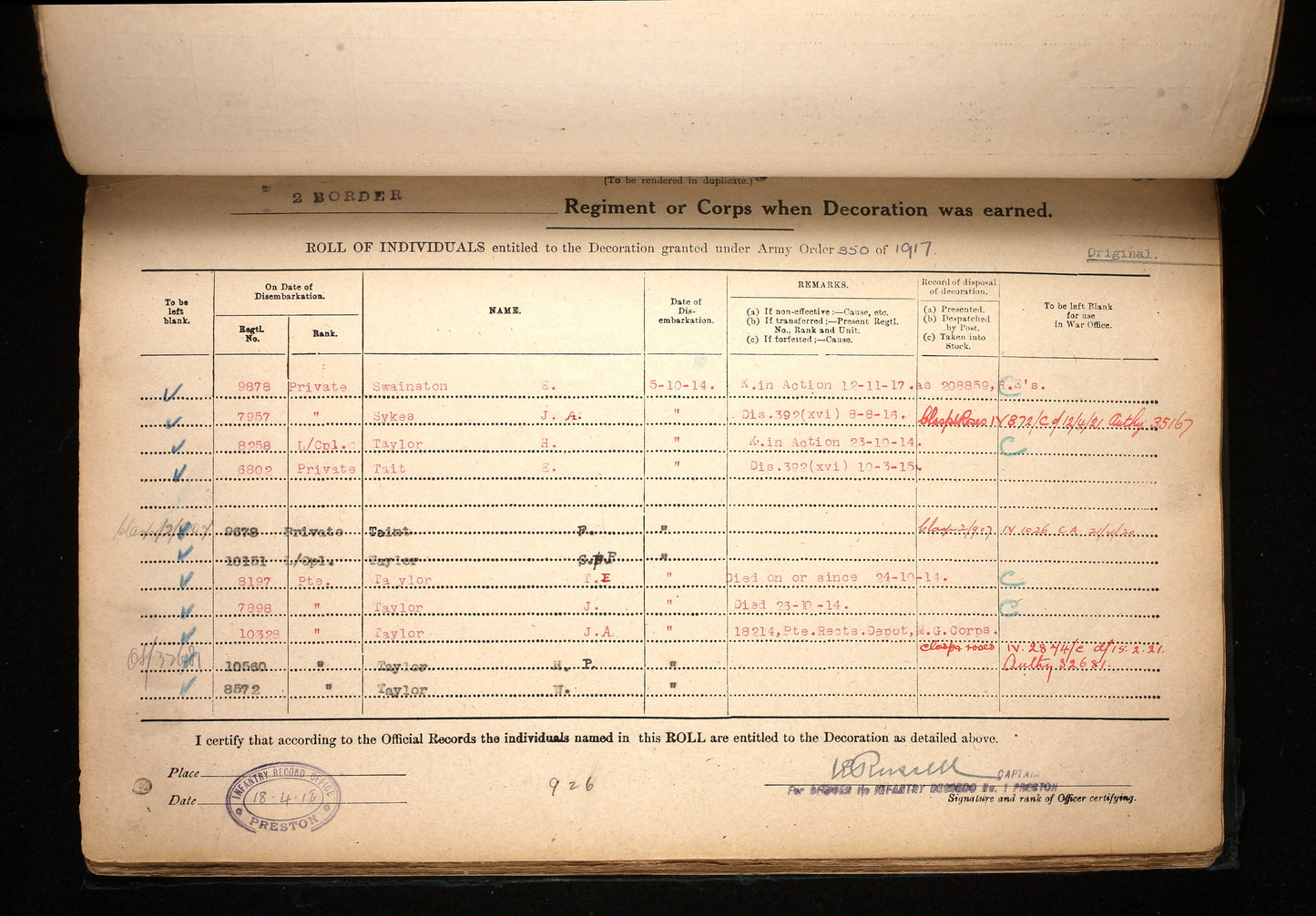
1914 Star with original clasp and rosette – 10560 PTE H. P. TAYLOR. 2/BORD:R.
British War Medal – L-10560 PTE. H. P. TAYLOR BORD. R.
Victory Medal – L-10560 PTE. H. P. TAYLOR BORD. R.
Medals nicely mounted as worn on original silk ribbons
The group comes with a large original archive including many documents, a photograph, his passport, and some postcards etc.
Harry Percy Taylor was born on 28 March 1893 in Plaistow, London, and grew up in the East End of London. Civil records and later census material show him living in the West Ham area, where he spent his early working life. Prior to and following the First World War he was employed as a general labourer, and later worked as a cleaner with the General Post Office, reflecting the type of steady civilian employment commonly taken up by returned soldiers. By 1921, Taylor was married and living at 58 Chandos Row, West Ham, and later records place him and his wife in Islington, London, by 1939.
Taylor enlisted into the British Army on 28 April 1913, entering regular service before the outbreak of the Great War. He was posted to the Border Regiment, serving initially with the 2nd Battalion. Following the outbreak of war, he proceeded overseas, arriving in France on 5 October 1914, and went on to serve on the Western Front during some of the most sustained periods of fighting.
During his time in France, Taylor was wounded on multiple occasions, reflecting prolonged front-line service. He was first wounded in action on 24 November 1914 while serving with the 2nd Battalion, Border Regiment. Records further note an additional wound sustained during September or October 1916, underlining the cumulative physical toll of his wartime service. He later sustained a gunshot wound to the left arm on 27 January 1917 while serving with the 1st Battalion, Border Regiment, a serious injury that would have required evacuation and hospital treatment.
At a later stage of the war, Taylor was transferred to the Royal Fusiliers, serving with the 43rd Garrison Battalion. Such units were typically responsible for guard and security duties, often employing men who had already seen extensive active service or who were no longer fully fit for continuous front-line duty, and his posting reflects both his experience and the effects of repeated wounds.
Following the end of the war, Taylor remained in the Army during the prolonged demobilisation period. He was finally discharged from service on 20 May 1921, having completed over eight years’ service, including significant wartime duty overseas and multiple wounds received in action.
In civilian life, Taylor married Emily Lloyd in December 1919, shortly after the war’s end. The couple had no children recorded in the 1921 Census, and Harry is shown as head of household. By the time of the 1939 England and Wales Register, he was living in Islington, still married to Emily, and employed with the G.P.O., indicating a settled post-war life following years of military service.
Harry Percy Taylor’s record is that of a long-serving pre-war soldier who endured repeated wounds during the First World War, served in multiple battalions and regiments, and successfully returned to civilian life. His service reflects the experience of many regular soldiers whose war did not end with a single wound or short tour, but stretched across years of sustained exposure to combat on the Western Front.
PLEASE NOTE: All research will be sent to the buyer via email. I am unable to provide printed copies, as I do not have access to a printer.
AJMS Medals