


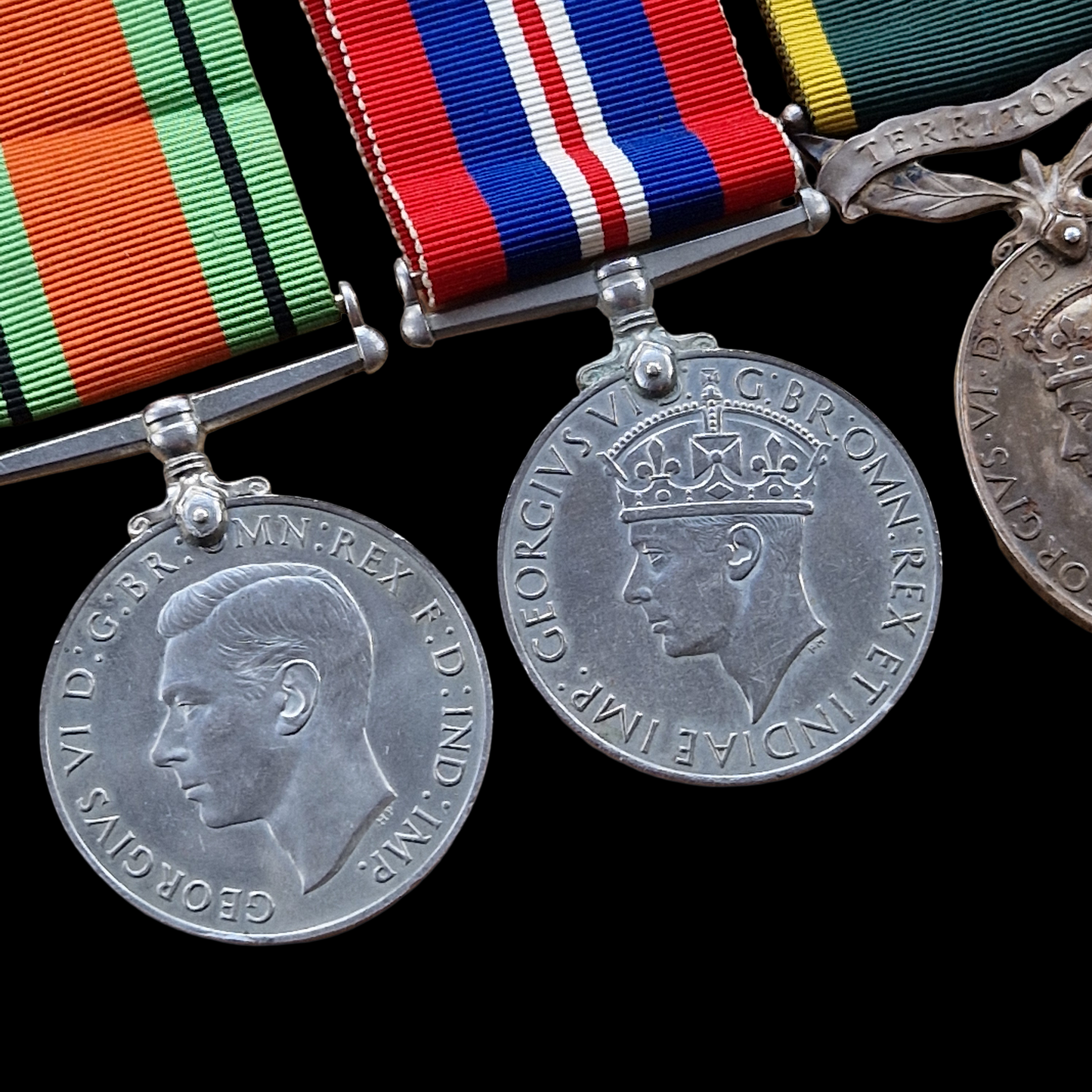
Second World War Medal Group – Battery Sergeant Major Richard McAlroy, 84th Searchlight Regiment, Royal Artillery
1939-45 Star – unnamed as issued
Defence Medal – unnamed as issued
War Medal – unnamed as issued
Territorial Efficiency Medal – 2029582 W.O.CL.II. R. MCALROY. R.A.
Richard McAlroy was born on 22 April 1899 at South Shields, County Durham, the son of Philip McAlroy and Annie Hunter. The 1921 Census records him aged 22, residing with his widowed mother and siblings in South Shields, and employed as a wagon lad above ground at St Hilda Colliery, firmly placing him within the industrial coal-mining community of the area. He later married Celestia Amelia Embleton in 1928, and remained in South Shields throughout his life, dying there in April 1973, aged 73.
He served in the Royal Artillery, holding the service number 2029582, and was a member of the 84th Searchlight Regiment, Royal Artillery (Territorial Army). His confirmed rank was Battery Sergeant Major, a senior Non-Commissioned Officer appointment, further supported by records showing entitlement to the Long Service and Good Conduct Medal with rank noted as Warrant Officer Class II—the equivalent rank associated with a Battery Sergeant Major in the Royal Artillery. This clearly indicates long and reliable service, likely extending into the pre-war Territorial Army.
The 84th Searchlight Regiment was formed on 20 December 1940 at Hereford during the rapid expansion of Britain’s air defences in response to the German bombing campaign known as The Blitz. The regiment comprised four batteries—512, 517, 518 and 519—and was assigned to Anti-Aircraft Command, tasked with defending key industrial and port areas in the Humber region and North Midlands of England.
McAlroy’s service in this unit placed him directly within Britain’s critical home defence network. Searchlight regiments performed a vital role during night air raids, operating powerful searchlights to locate, track, and illuminate enemy aircraft, allowing Heavy Anti-Aircraft guns and RAF night fighters to engage them. At the time, this work was carried out under dangerous and demanding conditions, often during sustained bombing attacks.
By early 1941, the regiment was operational as the Blitz reached its height. Initially, many of its batteries were inexperienced and deployed alongside seasoned units to gain practical experience, reflecting the urgency with which these formations had been raised.
The regiment saw particularly intense activity during the Hull Blitz, one of the most severe bombing campaigns outside London. Between March and May 1941, the city of Hull and surrounding Humber region were subjected to repeated night raids, including major attacks between 3rd and 9th May, during which widespread fires, destruction, and heavy civilian casualties were recorded. German aircraft frequently used parachute mines, causing extensive blast damage across the city. Searchlight units such as McAlroy’s played a key role in illuminating these raiders, contributing directly to aircraft being shot down by anti-aircraft guns and night fighters.
At this stage of the war, searchlights were deployed in clusters of three, spaced widely apart in an effort to maximise the chance of detecting aircraft. As the war progressed, the introduction of Searchlight Control (SLC) radar allowed for more effective single-light deployments, improving coordination with RAF fighter interception.
Even after the main phase of the Blitz, the Humber remained a target for continued minelaying and nuisance raids, with searchlight units tasked with detecting aircraft attempting to disrupt shipping routes. The regiment also operated specialised arrangements such as temporary ‘Firework’ batteries to counter aerial mining operations and experimental ‘Dazzle Barrage’ systems designed to confuse enemy pilots during attacks.
By 1942, the regiment was widely dispersed across Lincolnshire, Yorkshire, Nottinghamshire, and surrounding areas, protecting key industrial centres and airfields. During this period, McAlroy, as a Battery Sergeant Major, would have held significant responsibility for the discipline, administration, and operational efficiency of his battery, overseeing the men operating the searchlights and associated equipment.
He was discharged on 22 November 1942, prior to the eventual disbandment of the regiment in October 1943, when Anti-Aircraft Command was reduced as the Luftwaffe threat diminished and manpower was redirected towards offensive operations in preparation for the invasion of Europe.
Following his service, McAlroy applied for his campaign medals, with his entitlement confirmed as the 1939–45 Star, Defence Medal, and War Medal 1939–1945, reflecting his service within the United Kingdom in an operational air defence role. His application, dated 1949, records his address as 185 King George Road, South Shields, indicating he returned to civilian life in his home town following the war.
Overall, McAlroy’s service represents that of a senior Territorial Army NCO who served during the most critical period of Britain’s air defence, contributing to the protection of heavily targeted industrial regions during the Blitz. His confirmed rank of Battery Sergeant Major, combined with his award of the Long Service and Good Conduct Medal, reflects a soldier of experience, reliability, and responsibility within the Royal Artillery’s anti-aircraft forces.
PLEASE NOTE: All research will be sent to the buyer via email. I am unable to provide printed copies, as I do not have access to a printer.
AJMS Medals