


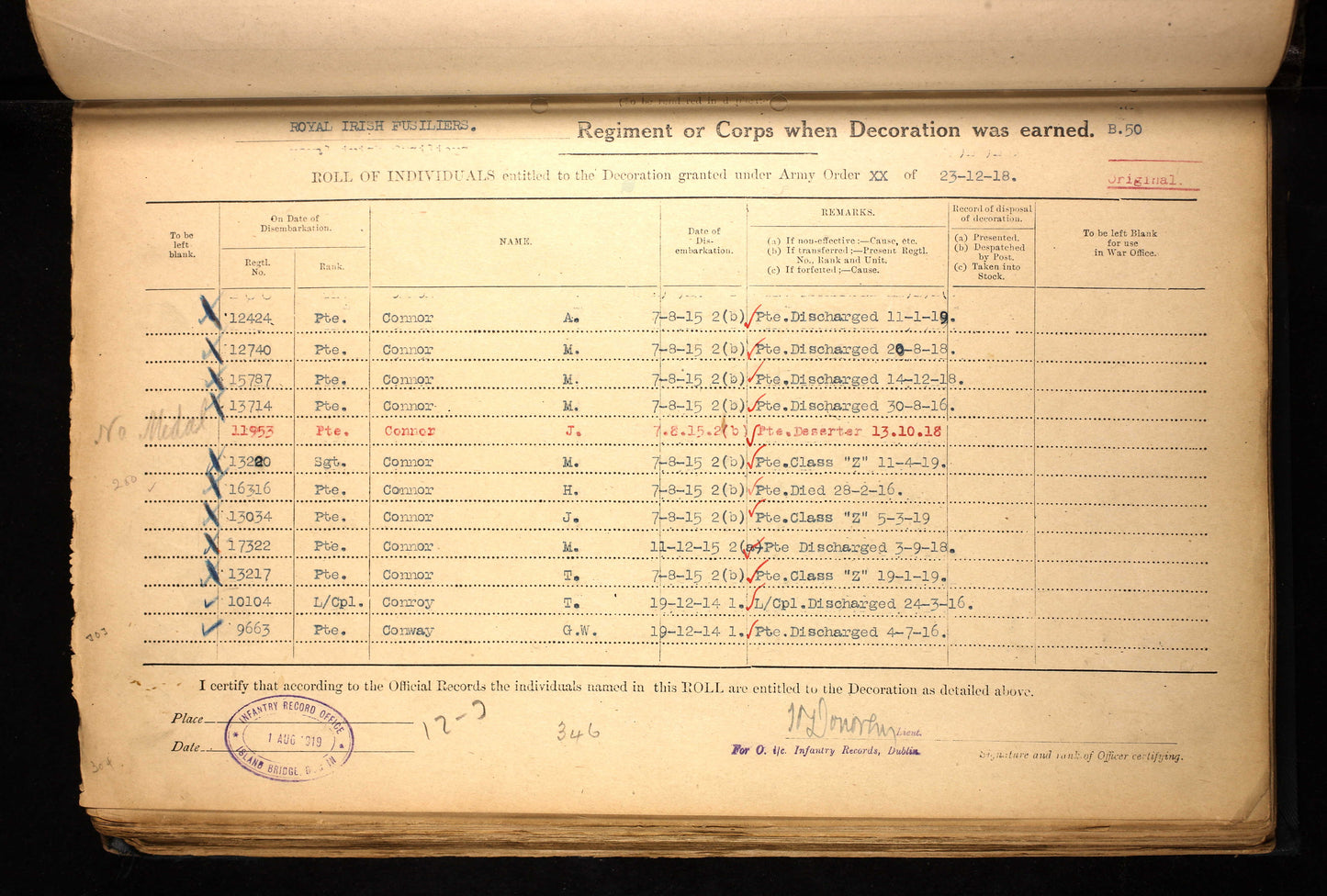
First World War British War Medal – Private Matthew Connor, 6th (Service) Battalion, Royal Irish Fusiliers – W.I.A. Gallipoli 9th August 1915
British War Medal (missing suspender) – 15787 PTE. M. CONNOR. R. IR. FUS.
Matthew Connor was born at Liverpool and later lived at Timperley Street, Widnes. He enlisted on 26th October 1914, aged 32, joining the 6th (Service) Battalion, Royal Irish Fusiliers, part of 31st Brigade, 10th (Irish) Division.
The 6th Royal Irish Fusiliers were raised at Armagh in August 1914 as part of Kitchener’s First New Army. After training in Ireland and later at Basingstoke, the battalion sailed from Liverpool on 7th July 1915 for the Mediterranean. Connor landed at Suvla Bay, Gallipoli, on 7th August 1915, taking part almost immediately in the August offensive.
Within forty-eight hours of landing, the battalion was heavily engaged in the fighting around Chocolate Hill, advancing across exposed ground in extreme heat and under intense shrapnel and rifle fire. On 9th August 1915, Connor was Wounded in Action, struck by shrapnel in the left calf during fierce fighting as the battalion pressed forward inland from Suvla.
He was evacuated to Nesrieh School Military Hospital, Cairo, and from there wrote home to his wife. His letter was subsequently published in the Widnes Weekly News and District Reporter (Friday 10 September 1915) under the heading:
“INJURED ROUTING THE TURKS.”
The newspaper account reads:
Private Matthew Connor, Timperley street, is, according to official notice of the 5th September, at Nesrieh School Military Hospital, Cairo, having been wounded by shrapnel in the left calf on the 9th August. He is in the Royal Irish Fusiliers.
Writing to his wife on the 14th August he says:—
“I am lying here in this hospital with a slight wound in the calf of the leg and a couple of bruises on the shin bone. It is nothing serious, so don’t be upset. It was done on Monday last, the 9th. It has gone on all right since and is nearly closed up. I can say that I was very lucky indeed, as there are plenty of Widnes lads wounded—and badly. I saw Cosgrove. He was wounded twice in the arm.
We got into a proper trap about 3.30 that morning and they did not forget us, and after us making such good progress on Saturday when we routed them for about four miles. We have lost nearly all our officers through wounds or killed, and it is a great pity, because given an opportunity to lead us, as they did on Saturday, we would have given them something to think about. We only lost 13 men on Saturday through wounds. Then our captain got wounded in the head and had to be taken away at one of the most important moments for us and everyone about, but we answered to the second in command, a smart chap but without the experience of our captain, who showed himself to be a really fine man on Saturday, and he was in raptures of joy with the show his company made.
He told us all about being ever alert; but he had no reason, for you forget there is such a thing as sleep or that you are hungry. If you can get a drink of water you are all right. You never get tired, and if you did happen to fall asleep you need not be frightened you will sleep on, because you won’t. They just send a knocker-up perhaps before you want to get up, and you rise if you can. They are very kind. This is a lovely place, but very hot.”
Private Connor worked at the Liverpool Silver and Copper Works and enlisted soon after the outbreak of war. He went to the Dardanelles five or six weeks ago. In Widnes he was well known as a footballer. Three brothers and two of his brothers-in-law are in the army.
Connor’s letter provides a vivid, contemporary account of the chaotic and costly fighting during the Suvla operations — describing the early advance, the losses among officers, the intense shrapnel fire, thirst, exhaustion, and the extraordinary spirit among the men despite the conditions.
The 6th Royal Irish Fusiliers were withdrawn from Gallipoli on 29th September 1915, moving via Mudros to Salonika, and later saw hard service in the Balkans. On 2nd November 1916, the battalion was absorbed by the 5th Royal Irish Fusiliers, a common wartime reorganisation due to losses.
Connor’s wounds were bad enough to see him placed out of active service and put to work in a munitions factory near home.
Matthew Connor’s Gallipoli wound places him squarely in the opening and most critical phase of the Suvla fighting — a soldier of the New Army who was in action within days of landing and whose own words survive to describe the experience.
PLEASE NOTE: All research will be sent to the buyer via email. I am unable to provide printed copies, as I do not have access to a printer.
Visit my website for better prices on most of my stock.
AJMS Medals