


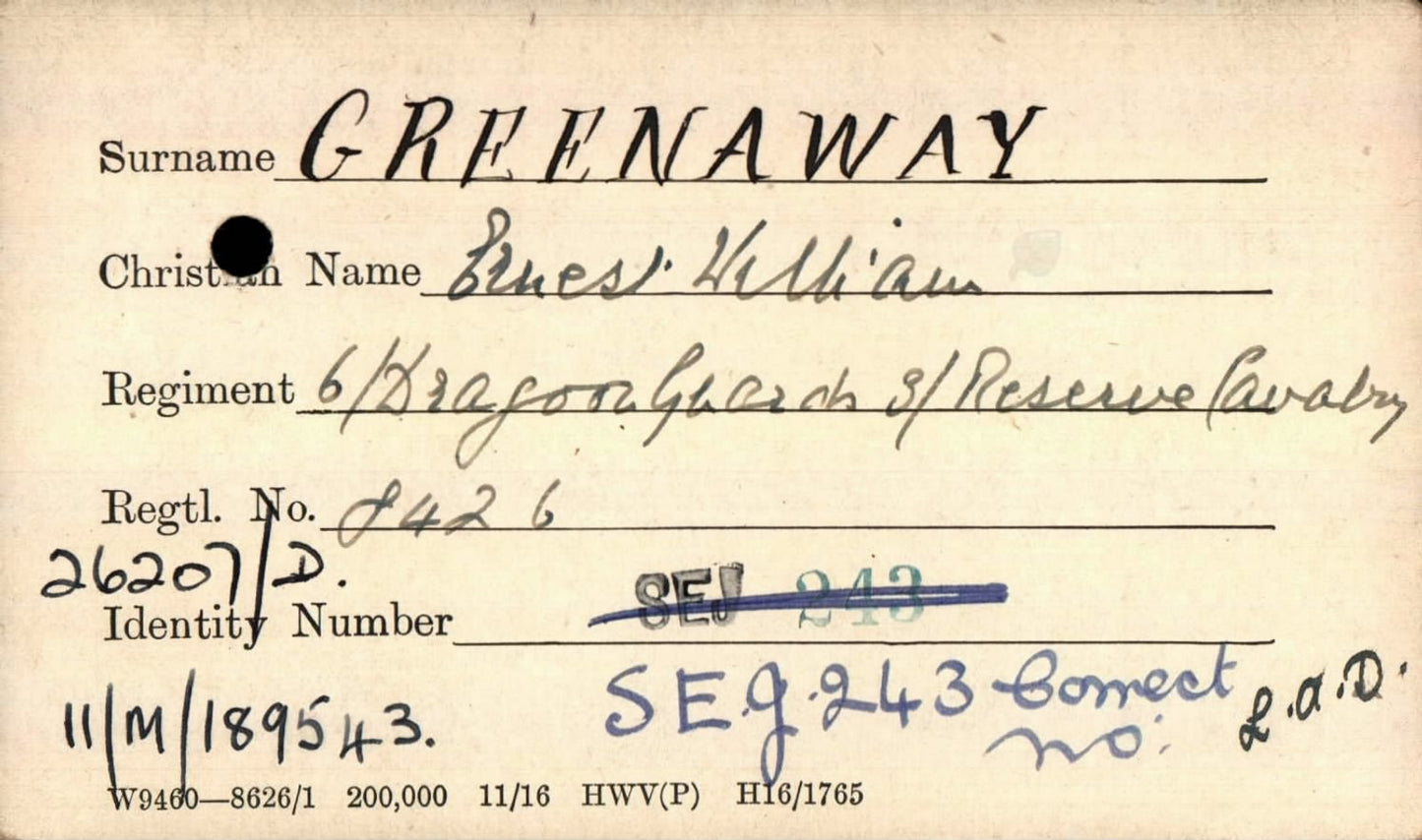
First World War1914 Mons Star Medal Trio – Trooper Ernest William Greenaway, 6th Dragoon Guards (Carabiniers), attached to the 1st Life Guards
1914 Star with genuine clasp – 8426 PTE. E. W. GREENAWAY. 6/DNS:
British War Medal – D-8426 PTE. E. W. GREENAWAY. 6-D. GDS.
Victory Medal – D-8426 PTE. E. W. GREENAWAY. 6-D. GDS.
Together with a cap badge, presumed to be a copy.
Ernest William Greenaway was born at Notting Hill, London, in about 1894, and was baptised at All Saints, Notting Hill, on 11th February 1894. He was the son of Frederick Greenaway and Martha Johnson, and was raised in the Hammersmith / Shepherd’s Bush area, appearing in the 1911 Census aged 17, living at 49 Cobbold Road, Shepherd’s Bush, and working as a leather strap finisher in a trunk factory — a skilled trade closely associated with London’s leatherworking districts.
He enlisted into the 6th Dragoon Guards (Carabiniers) on 9th October 1913, aged 19, joining at the regiment’s depot at Newport, Monmouthshire. His civilian occupation is consistently recorded as trunk maker, and his service record survives online in good detail. A clear studio photograph of Greenaway in his 6th Dragoon Guards uniform is also available via Ancestry, showing him as a pre-war regular cavalryman.
At the outbreak of war in August 1914, the 6th Dragoon Guards were stationed at Canterbury, forming part of 4th Cavalry Brigade. They embarked for France in the opening weeks of the war, and Ernest William Greenaway arrived in France on 15th September 1914, joining the British Expeditionary Force during the crucial mobile phase following the Retreat from Mons.
On 9th November 1914, Greenaway was attached from the 6th Dragoon Guards to the 1st Life Guards, and is recorded thereafter as serving with that regiment. This attachment places him directly in the cavalry fighting of October–November 1914, and he will have seen active service during the First Battle of Ypres, when the cavalry divisions were repeatedly used to plug gaps, screen infantry movements, and hold exposed sectors under intense pressure.
The conditions endured by cavalrymen during this period were exceptionally severe. Although trained for mobile warfare, the Life Guards and Dragoon regiments were frequently dismounted and used as infantry, holding muddy trenches, manning improvised defensive lines, and operating under constant shellfire and exhaustion. It was during this period of sustained strain that Greenaway’s health began to fail.
On 10th December 1914, he was admitted to No. 10 General Hospital, Rouen, suffering from Disordered Action of the Heart (DAH) — a condition commonly associated with prolonged stress, exposure, and over-exertion during the early months of the war. His hospital admission record describes him as a Trooper of the 1st Life Guards, confirming that his attachment was active at the time of his illness. On the same date, 10th December 1914, he was invalided home to the United Kingdom.
Despite further assessment, his condition did not sufficiently improve, and Ernest William Greenaway was formally discharged from the British Army on 10th May 1915, being classed as physically unfit for further service. His total overseas service amounted to nearly three months, all of it during one of the most demanding phases of the war, when the BEF was fighting for survival in Flanders.
Greenaway survived the war and later returned to civilian life. By 1921, he was living at 121 Duke Road, Chiswick, employed as an omnibus driver with the London General Omnibus Company, and supporting a family. He later remarried and remained in Middlesex for the rest of his life, dying at Enfield in December 1984.
Ernest William Greenaway’s service represents that of a pre-war regular cavalryman, mobilised immediately for active service, present during the fighting of First Ypres, and ultimately broken in health by the physical demands of early trench warfare. His documented attachment to the 1st Life Guards, combined with a surviving photograph and full service record, makes his career particularly well-evidenced and historically significant.
PLEASE NOTE: All research will be sent to the buyer via email. I am unable to provide printed copies, as I do not have access to a printer.
Visit my website for better prices on the majority of my stock.
AJMS Medals