
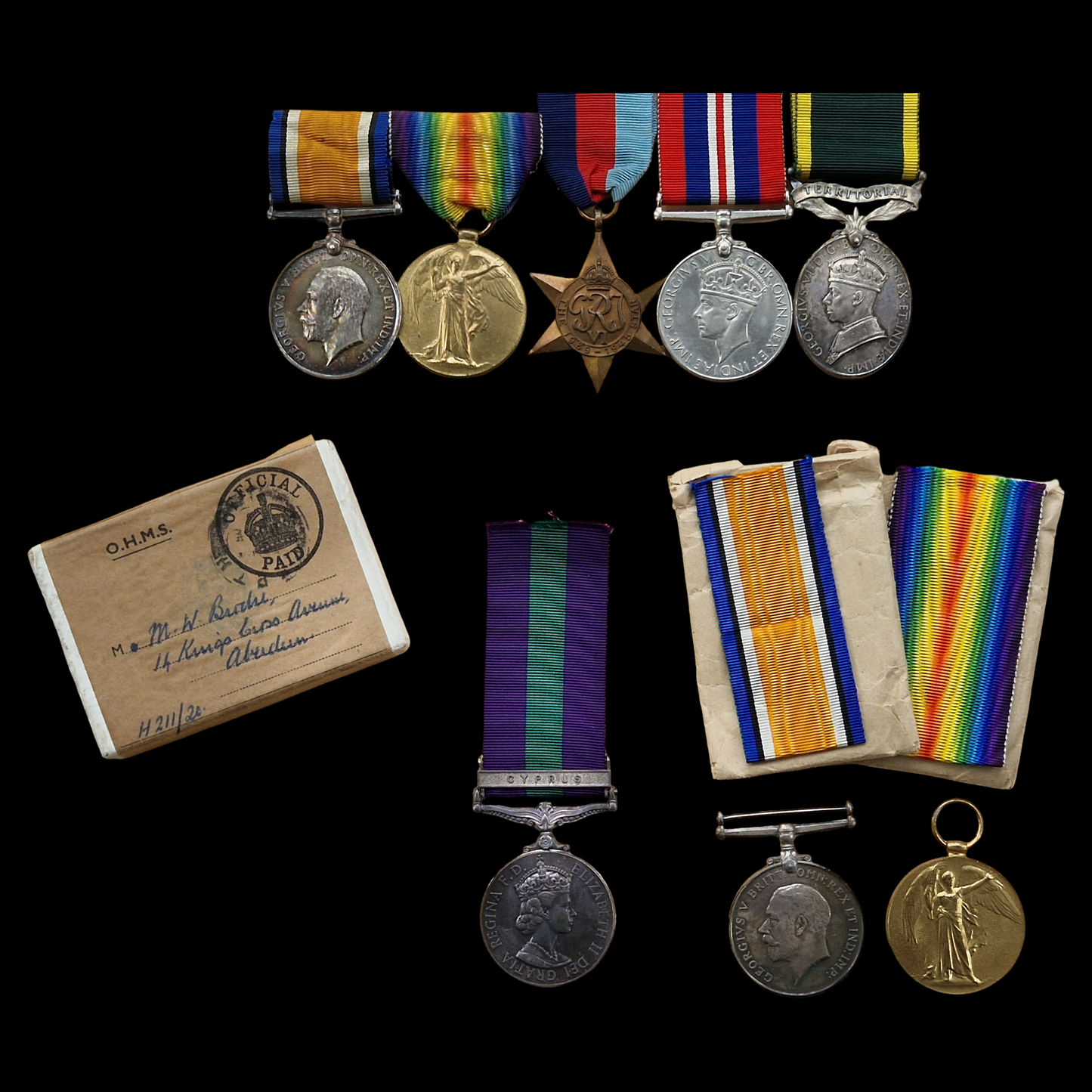
Brodie Family Medal Collection – Two Brothers of the First World War and Son:
Colour Sergeant Matthew Wylie Brodie, Gordon Highlanders, Captured at St Valery 1940 and POW for Nearly Five Years
Private Hugh Brodie, Scottish Rifles, Died of Wounds 1918
Sergeant Hugh Brodie, Royal Army Educational Corps, Died on Active Service in Cyprus 1957
First & Second World War Medal Group – Colour Sergeant Matthew Wylie Brodie, Gordon Highlanders, Late Scottish Rifles – Wounded in 1918 and Prisoner of War after St Valery, 1940–45
British War Medal – 39836 PTE. M. W. BRODIE. SCO. RIF.
Victory Medal – 39836 PTE. M. W. BRODIE. SCO. RIF.
1939–45 Star – unnamed as issued
War Medal – unnamed as issued
Territorial Efficiency Medal – 2878478 C.SJT. M. W. BRODIE. GORDONS
Matthew Wylie Brodie was born in Glasgow on 4 September 1896, the son of Hugh and Annie Brodie. In the 1901 Census he was living with his family at 218 Allison Street, Glasgow, the same address later recorded as his next-of-kin address during the First World War.
Brodie served during the First World War with the Scottish Rifles, under service number 39836, and later with the 12th Battalion, Highland Light Infantry, under service number 45476. He was wounded during the closing stages of the war, suffering gunshot wounds to the abdomen and buttocks, and his name appeared in a War Office wounded list dated 4 November 1918. His First World War pair was issued in his Scottish Rifles number and regiment.
After the war Brodie continued his connection with the Army and later joined the Territorial Army, serving with the Gordon Highlanders. By the outbreak of the Second World War he was an experienced senior non-commissioned officer. His post-war records show him as Colour Sergeant, service number 2878478, and his Territorial Efficiency Medal was issued in that rank and regiment.
Brodie had joined the Territorial Army in March 1937 and was serving with the 5th Battalion, Gordon Highlanders, part of the 51st (Highland) Division. By 1940 he was serving at brigade level with Headquarters, 153rd Infantry Brigade.
During the German offensive in France, the 51st Highland Division became isolated from the main British Expeditionary Force and was eventually forced back towards St Valery-en-Caux. Brodie was among the large number of men captured when the division surrendered there on 12 June 1940.
The surviving casualty records initially listed him as missing in France before confirming that he was a prisoner of war. His rank was variously recorded as Sergeant, Staff Sergeant and later corrected to Colour Sergeant. His service number throughout his Second World War records was 2878478.
At the time of his capture Brodie gave his home address as:
14 King's Cross Avenue
King's Cross
Aberdeen
His liberation questionnaire records that he was serving with the 5th Battalion, Gordon Highlanders, with a note linking him to Headquarters, 153rd Infantry Brigade, and confirms his capture at St Valery, France, on 12 June 1940.
Brodie was first held at Stalag XXB, Marienburg, where he remained from approximately 1941 until 1944. Unlike many prisoners attached to working detachments, Brodie recorded that he was employed as a Camp Leader and did not undertake normal labour. His questionnaire specifically notes that although the camp was a working establishment, he himself was not required to work in the usual sense, reflecting the administrative and supervisory position he held among the prisoners.
In June 1944 he was transferred to Stalag 357, where he remained until April 1945. Stalag 357 became one of the principal camps for British prisoners during the final phase of the war, and Brodie was still held there as Allied forces advanced into Germany.
His prisoner-of-war number was 15394.
Brodie's surviving ex-prisoner questionnaire records no serious illness during captivity. He had therefore endured almost five years as a German prisoner of war following the fall of St Valery.
By July 1945 the War Office recorded him as no longer a prisoner of war, with his previous theatre of war given as France. His wartime medal entitlement comprised the 1939–45 Star and War Medal, while his long Territorial service was additionally recognised by the award of the Territorial Efficiency Medal, authorised in 1946.
Brodie was finally discharged on 9 August 1945.
This is a particularly strong and historically significant family medal group to a soldier whose career spanned both World Wars: wounded while serving with the Scottish Rifles and Highland Light Infantry in 1918, later a senior Territorial NCO of the Gordon Highlanders, captured with the 51st Highland Division at St Valery in June 1940, and held as a prisoner of war in Germany for almost five years before liberation in 1945.
First World War Medal Pair – Private Hugh Brodie, 12th Battalion, Highland Light Infantry, Late Scottish Rifles – Died of Wounds, 30 September 1918, Aged 20
British War Medal – 38312 PTE. H. BRODIE. SCO. RIF.
Victory Medal – 38312 PTE. H. BRODIE. SCO. RIF.
Hugh Brodie was born in Glasgow in about 1898, the son of Hugh Brodie and Annie Meikle Wylie Brodie, who during the war were living at 218 Allison Street, Glasgow.
Brodie enlisted in Glasgow and initially served with the Scottish Rifles, under service number 38312, the number and regiment impressed upon his British War and Victory Medals. Surviving military records show that his service subsequently took him into the Highland Light Infantry, where he served under the number 45497. The surviving administrative entry records him first as:
38312 Private Hugh Brodie – Scottish Rifles
and subsequently with the:
12th Battalion, Highland Light Infantry
By the closing stages of the First World War Brodie was serving overseas with “C” Company, 12th Battalion, Highland Light Infantry, part of the 106th Brigade, 35th Division. His records also note earlier or intermediate service connected with the Scottish Rifles and reinforcement organisation before his posting to the Highland Light Infantry.
Brodie was wounded during the final months of the war and died of his wounds on 30 September 1918, aged only 20. His death occurred little more than six weeks before the Armistice. The official Soldiers Died in the Great War record confirms that he died of wounds while serving with the 12th Highland Light Infantry in France and Flanders.
His death resulted in a dependant's pension claim by his father, Hugh Brodie, of 218 Allison Street. The surviving pension record again gives the cause of death simply and starkly as:
“30.9.18 – Died of wounds.”
Private Brodie was buried in Lijssenthoek Military Cemetery, Belgium, in Plot XXIV, Row E, Grave 27A. His family chose the personal inscription:
“TRUE HEARTED FAITHFUL AND LOYAL TO KNOW HIM WAS TO LOVE HIM”
Lijssenthoek was one of the principal hospital and casualty-clearing-centre cemeteries behind the Allied lines in the Ypres sector, and Brodie's burial there is consistent with his having been evacuated for medical treatment after being wounded before succumbing to his injuries.
A poignant First World War casualty pair to a young Glasgow soldier who began his service with the Scottish Rifles, as reflected by the naming on his medals, before transferring to the Highland Light Infantry, ultimately dying of wounds while serving with “C” Company, 12th Battalion H.L.I. during the final weeks of the war.
General Service Medal – Sergeant Hugh Brodie, Royal Army Educational Corps, Attached 1st Battalion Suffolk Regiment – National Serviceman & Glasgow School of Art Graduate, Died on Active Service in Cyprus, 4 June 1957
General Service Medal 1918–62, clasp Cyprus – 23325936 SGT. H. BRODIE. R.A.E.C.
Hugh Brodie was born on 16 November 1932, the son of Matthew Wylie Brodie, the veteran Gordon Highlander who had been captured with the 51st Highland Division at St Valery in 1940. Hugh shared his name with his father's younger brother, Private Hugh Brodie, who had died of wounds while serving with the 12th Highland Light Infantry in September 1918.
Before entering the Army, the younger Hugh Brodie showed considerable promise as an artist. He attended Aberdeen Grammar School before studying at Gray's School of Art, Aberdeen, from 1950 to 1952, subsequently moving to the Glasgow School of Art. He gained his Diploma in Drawing and Painting in 1954, and in the same year was awarded a minor travelling bursary of £20. His ability was further recognised in 1955 when he received a post-Diploma Haldane Travelling Scholarship of £75.
Brodie was subsequently called up for National Service and served with the Royal Army Educational Corps, service number 23325936, attaining the rank of Sergeant. During the Cyprus Emergency he was attached to the 1st Battalion, Suffolk Regiment, and by 1957 had been serving on the island for approximately four months.
His General Service Medal with Cyprus clasp reflects his service during the campaign against EOKA, but Brodie did not live to return home.
On 4 June 1957, at the age of only 24, he died while serving in Cyprus.
There is some conflict between surviving sources regarding the circumstances of his death. A later Cyprus Emergency roll records Brodie as having been "shot while chasing terrorist". Contemporary newspaper reporting, however, gives a very different and considerably more detailed account. The latter reported that Brodie and eight other servicemen had been swimming off a beach in northern Cyprus when a sudden storm caused the party to get into difficulties. Two British airmen serving as volunteer lifesavers succeeded in bringing the men ashore, but Brodie subsequently died in hospital.
One contemporary report stated:
"The soldier drowned in a swimming accident in Cyprus yesterday was Sgt. H. Brodie (24), a National Serviceman..."
A further newspaper account revealed the particularly tragic circumstances. Shortly before his death Brodie had written home to his mother at 51 Atholl Drive, Giffnock, Glasgow, remarking that the only way he could keep cool in Cyprus was by swimming. The following day she received a War Office telegram informing her that her son had drowned.
The same report described Hugh as a Glasgow art student until called up the previous July, and confirmed that he was serving with the Royal Army Educational Corps while attached to the 1st Suffolk Regiment.
Given the specificity and contemporaneous nature of these newspaper reports, the evidence strongly favours accidental drowning during the swimming incident as the true circumstances of his death, rather than the later secondary reference to his having been shot.
Brodie's artistic interests evidently continued during his military service. A painting attributed to him, depicting a Mediterranean coastal scene, has survived within the family and was later shared online by a relative seeking information about Hugh and the location he had painted during his time in Cyprus.
Sergeant Hugh Brodie was buried at Wayne's Keep Military Cemetery, Nicosia, in Plot 24, Row B, Grave 16. His death is recorded on the post-1945 military Roll of Honour and on the Armed Forces Memorial.
A particularly poignant General Service Medal to a young Scottish National Serviceman, artist and Royal Army Educational Corps Sergeant who died while serving during the Cyprus Emergency, aged only 24. The medal also forms the final generation of an exceptional Brodie family military group spanning from the First World War, through the fall of St Valery and almost five years of German captivity during the Second World War, to the Cyprus Emergency of the 1950s.
PLEASE NOTE: All research will be sent to the buyer via email. I am unable to provide printed copies, as I do not have access to a printer.
AJMS Medals