


First World War Medals – Private Hugh Smith, 4th Bn. Cameron Highlanders, later 7th Bn.
1914-15 Star – 1014. PTE. H. SMITH. CAM'N HIGHRS.
British War Medal – 1014 PTE. H. SMITH. CAMERONS. **RENAMED**
Victory Medal – 1014 PTE. H. SMITH. CAMERONS.
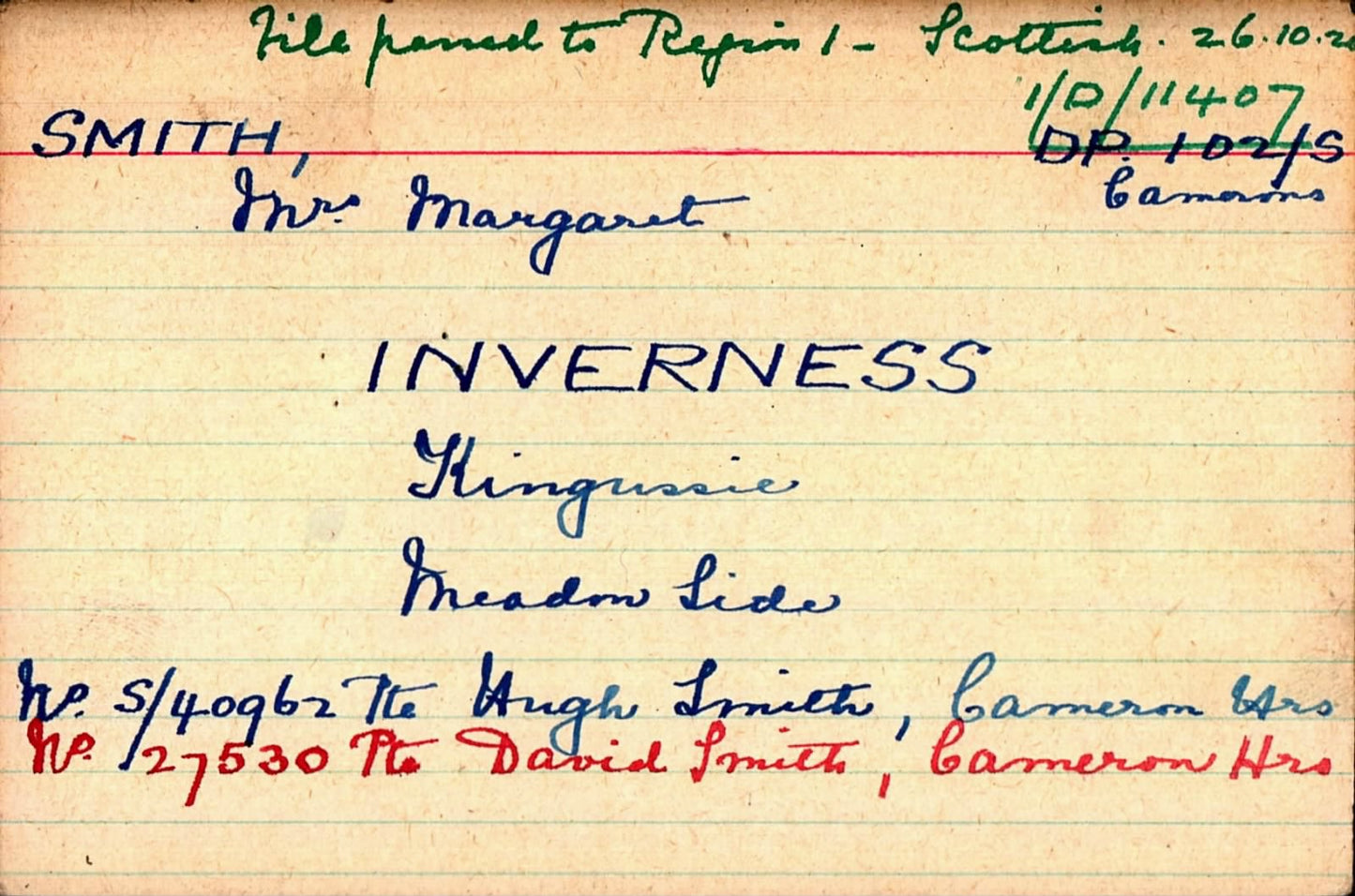
Hugh Smith was born on 28 September 1893 at Kincraig, Inverness-shire, the son of the late Hugh Smith and Margaret Smith (née Reid) of Meadowside, Kingussie. He was educated at Alvie Public School and prior to enlistment was employed as a farm servant, working locally in the Kingussie district, including at Croftcarnoch, reflecting the rural background typical of many pre-war Cameron Highlanders.
Smith enlisted into the Territorial Force on 18 March 1910, joining the 4th Battalion, Queen’s Own Cameron Highlanders, and was issued regimental number 1014. Like many Highland Territorials, he balanced military commitments alongside civilian employment, training annually while remaining rooted in his local community. Upon the outbreak of the First World War, he was called up on mobilisation in August 1914, volunteering for overseas service at an early stage when trained men were urgently required.
He embarked for France on 19 February 1915, entering the theatre of war with the British Expeditionary Force during a critical period of trench consolidation following the battles of 1914. Smith served continuously in France and Flanders throughout 1915, experiencing the grinding realities of trench warfare on the Western Front. His service during this period qualified him for the 1914–15 Star, marking him as an early overseas Territorial volunteer. Private Smith and the 4th Camerons saw action during the battles of Neuve Chapelle, Aubers Ridge, Festubert, Givenchy, and Loos.
On 29 March 1916, Smith was discharged on the expiry of his original period of engagement, a fate common to many pre-war Territorials whose initial terms had elapsed. However, rather than remaining at home, he re-enlisted, again joining the 4th Battalion, Cameron Highlanders, receiving the new regimental number 4993. He was subsequently transferred to the 7th Battalion, Cameron Highlanders, and renumbered S/40962, reflecting the wartime restructuring and standardisation of service numbers within the regiment.
Smith returned to active service in France and Flanders, now serving with a Service battalion during the later, highly attritional phases of the war. In August 1917, the Cameron Highlanders were engaged in operations south-east of Ypres, during the opening stages of the Third Battle of Ypres (Passchendaele), a campaign characterised by heavy fighting, machine-gun fire and mounting casualties in appalling ground conditions.
Private Hugh Smith was killed in action on 23 August 1917, aged 23, while advancing to attack the enemy under heavy machine-gun fire, south-east of Ypres. Contemporary accounts and regimental correspondence confirm the circumstances of his death. Sergeant-Major D. P. Fraser later wrote to Smith’s family, stating:
“There are many sad homes caused by the war, but you have the consolation that your son came to France voluntarily early in the war when men were badly needed; he did his bit and died a soldier’s death advancing to attack the enemy under heavy machine-gun fire.”
His death was widely reported in the local press, including notice that Mrs Smith of Meadowside, Kingussie had been informed of the loss of her son, and that she had another son serving with the Camerons at the Front, underlining the family’s contribution to the war effort. A photograph of Hugh Smith appeared in the People’s Journal.
Having no known grave, Hugh Smith is commemorated on the Tyne Cot Memorial, Belgium, Panel 136 to 138, the memorial bearing the names of those who fell in the Ypres Salient whose bodies were never recovered or identified. He is also remembered on the Kincraig War Memorial, Kincraig, Inverness-shire.
Important medal note: The British War Medal in this group is renamed. This is noted clearly and transparently, as the group was acquired at auction without prior disclosure of this alteration.
PLEASE NOTE: All research will be sent to the buyer via email. I am unable to provide printed copies, as I do not have access to a printer.
AJMS Medals