


Corporal William Anderson Masterton, 3rd Highland Field Ambulance, Royal Army Medical Corps, attached 1/6th Battalion Black Watch – Killed in Action, Third Ypres 1917
1914-15 Star – 1796 CPL. W. MASTERTON, R.A.M.C.
British War Medal – 1796 CPL. W. MASTERTON, R.A.M.C.
Victory Medal – 1796 CPL. W. MASTERTON, R.A.M.C.
Memorial Plaque – WILLIAM MASTERTON
William Anderson Masterton was born at Maxwelltown, Forfarshire, circa 1884–1885, the illegitimate son of Ann Anderson, who later married Allan Masterton. Census and family records show the family living in Dundee throughout his early life, first at 27 South George Street and later at 6 Eliza Street. William worked as a Plasterer prior to the outbreak of the Great War and married Wilhelmina Mort Gilmour at Dundee in 1911. At the time of his enlistment the couple were residing at 23 Langlands Street, Dundee.
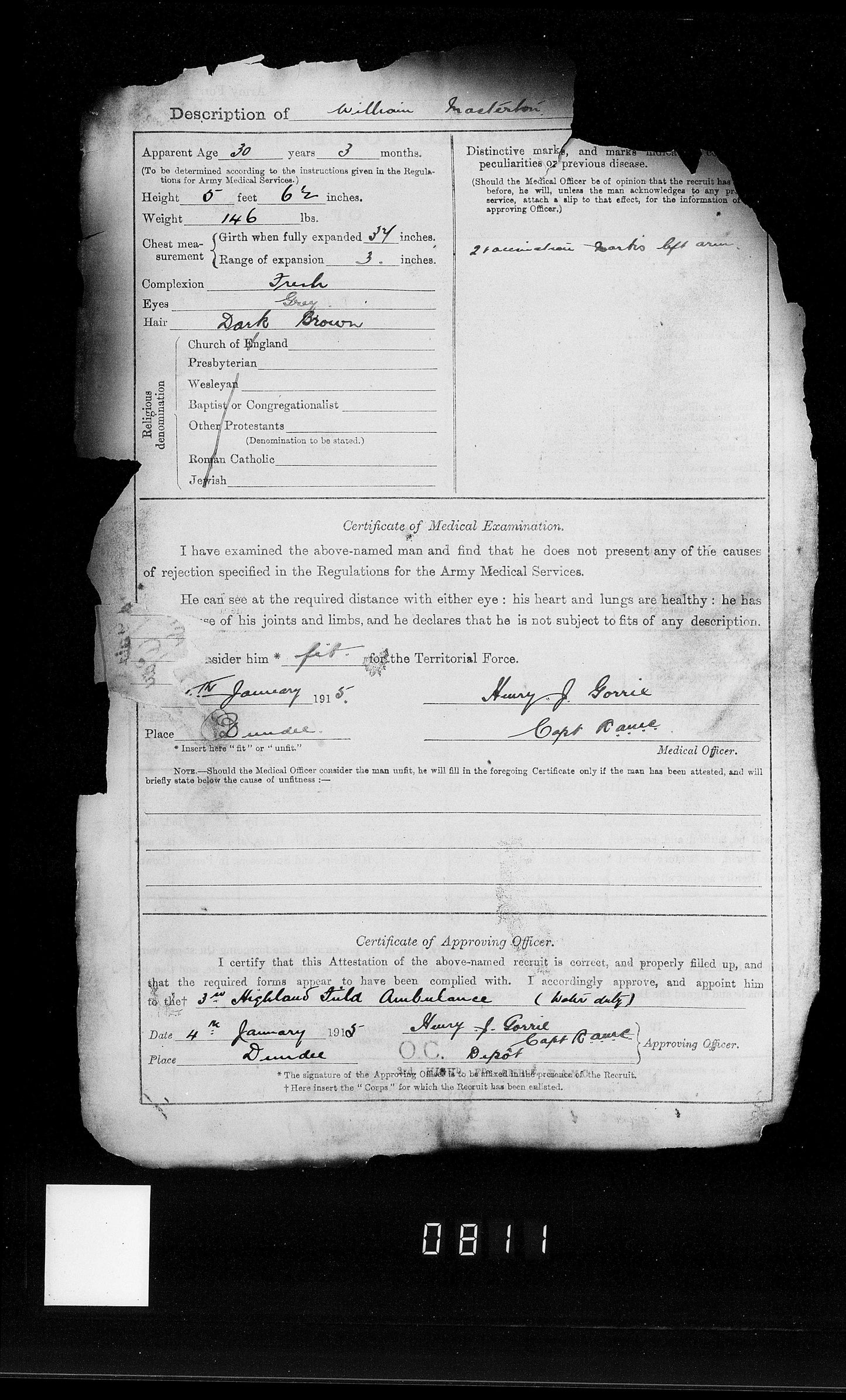
Masterton enlisted into the Territorial Force at Dundee on 4 January 1915, joining the 3rd Highland Field Ambulance, Royal Army Medical Corps, receiving the service number 1796, later renumbered 305234. His attestation papers describe him as aged 30 years and 3 months, standing 5 feet 6½ inches tall, weighing 146 lbs, with grey eyes and dark brown hair. He was medically classified fit for service and rapidly advanced within the unit, being promoted to Corporal on 10 February 1915.
The 3rd Highland Field Ambulance formed part of the famous 51st (Highland) Division, one of the most highly regarded British formations of the war. The Field Ambulance units of the R.A.M.C. were mobile front-line medical organisations responsible for collecting, treating and evacuating wounded men from the battlefield. Operating between the Regimental Aid Posts near the front line and the larger dressing stations to the rear, these units often worked under direct shellfire whilst handling enormous casualty numbers during major offensives.
Masterton embarked for France aboard the S.S. Onward, leaving Folkestone on 2 May 1915 and disembarking at Boulogne the same day. The 51st (Highland) Division had been rushed to France in the aftermath of the Second Battle of Ypres, where the Germans had first used poison gas on the Western Front. Masterton thereafter served continuously in France and Flanders for over two years, enduring the brutal conditions of trench warfare whilst attached to front-line infantry formations.
His surviving service papers record several periods connected with illness and front-line medical duties. In February 1916 he was admitted to the 2/2 Scottish General Hospital at Craigleith, Edinburgh, suffering from Influenza, before being discharged back to duty on 11 February 1916. In September 1916 he was again admitted to a Casualty Clearing Station suffering from Dental Caries, rejoining his unit later that month. These records illustrate the constant physical strain endured even by medical personnel serving close behind the front.
At the time of his death, Masterton was attached to the 1/6th Battalion, Black Watch (Royal Highlanders), part of the 153rd Brigade, 51st (Highland) Division. During the summer and autumn of 1917 the division was heavily engaged in the Third Battle of Ypres (Passchendaele), particularly during the fighting around the Steenbeek and the Langemarck sector. The 1/6th Black Watch took part in the Division’s advance during the opening phases of the offensive on 31 July 1917, suffering severe casualties amidst the mud, shellfire and devastated landscape of Flanders.
Corporal Masterton was Killed in Action on 11 September 1917, aged 33, whilst serving with the battalion in France and Flanders. Although the precise circumstances of his death are unrecorded, the battalion had recently been holding positions near Langemarck, north-east of Ypres, following the costly fighting of the Passchendaele offensive. His death was officially reported in the casualty lists as:
“R.A.M.C., att. Black Watch – Masterton, 305234, Cpl. W. (Dundee)”
He is buried at Gwalia Cemetery, Belgium, where his Commonwealth War Graves Commission headstone records him as:
“305234 Corporal W.A. Masterton, Royal Army Medical Corps, 11th September 1917, Age 33.”
The headstone further records him as the son of Allan and Annie Anderson Masterton, and the husband of Wilhelmina M. Masterton, of 27 Clepington Street, Dundee. Surviving pension and effects records show his widow later received a weekly pension following his death. Tragedy also struck the wider family during the war, as his brother, George Ellis Masterton, serving with the Army Cyclist Corps, had already died of wounds in 1916.
Masterton’s service represents the often overlooked sacrifice of the Royal Army Medical Corps during the Great War — men who worked tirelessly under fire to recover and treat the wounded whilst enduring the same dangers as the infantry they supported. His service with the renowned 51st (Highland) Division, attachment to the Black Watch, and death during the Passchendaele campaign make him a particularly compelling Scottish Great War casualty.
PLEASE NOTE: All research will be sent to the buyer via email. I am unable to provide printed copies, as I do not have access to a printer.
AJMS Medals