


Second World War Medal Group – Trooper Leslie Henry Waud, 3rd Carabiniers (Prince of Wales’s Dragoon Guards), Royal Armoured Corps – Killed in Action Battle of Imphal May 1944
1939-45 Star – unnamed as issued
Burma Star – unnamed as issued
Defence Medal – unnamed as issued
War Medal – unnamed as issued
With named casualty slip and box of issue addressed: 62 Morgan Road, Bromley, Kent
Leslie Henry Waud, born 25 December 1910 in Islington, London, was the son of a London family recorded in the 1911 Census as living at 31 Elmore Street, Islington, where he appears as an infant under the name Leslie Wand, an alternative spelling of the surname clearly shown in the records. By the time of the 1921 Census, he was recorded as Leslie Henry Waud, aged 10 years 6 months, living at 2 Londesborough Road, Stoke Newington, confirming his upbringing in North London.
By 1939, at the outbreak of the Second World War, he was living in Deptford, London, and is recorded in the 1939 Register as Leslie H. Waud, aged 29, married to Alice E. J. Waud (later confirmed as Alice Elizabeth Isabel Waud). His occupation is given as “Semi-skilled labourer” in what appears to be munitions-related work, indicating that he was already engaged in war industry employment at the outset of the conflict.
He later enlisted into the Royal Armoured Corps, serving as Trooper 4041168 Leslie Henry Waud with the 3rd Carabiniers (Prince of Wales’s Dragoon Guards). This regiment, originally stationed in India at the outbreak of war, did not initially see combat but was later committed to the Burma theatre following Japan’s entry into the war. By December 1943, the regiment had been deployed to North-East India as part of the 254th Indian Tank Brigade, equipped with M3 Lee medium tanks, and prepared to meet the advancing Japanese forces.
Waud’s service placed him in the midst of one of the most critical campaigns of the war in the East—the Battle of Imphal, which began in March 1944 as part of the Japanese U-Go offensive. This was a desperate and large-scale attempt by Japanese forces to invade India, and the fighting that followed was intense, prolonged, and often conducted in extremely difficult jungle terrain. The 3rd Carabiniers played a key role in halting this advance, operating often in small detachments and under constant threat from ambush, anti-tank attack, and the harsh environmental conditions of the region.
In April 1944, during the fighting around Nunshigum Ridge, tanks of the regiment supported infantry assaults in steep and exposed terrain, where tank commanders were forced to operate with limited visibility and under significant danger from elevated enemy positions. The regiment continued in continuous operations throughout the Imphal campaign, contributing to the eventual Allied victory, which culminated with the lifting of the siege following the success at Kohima in June 1944.
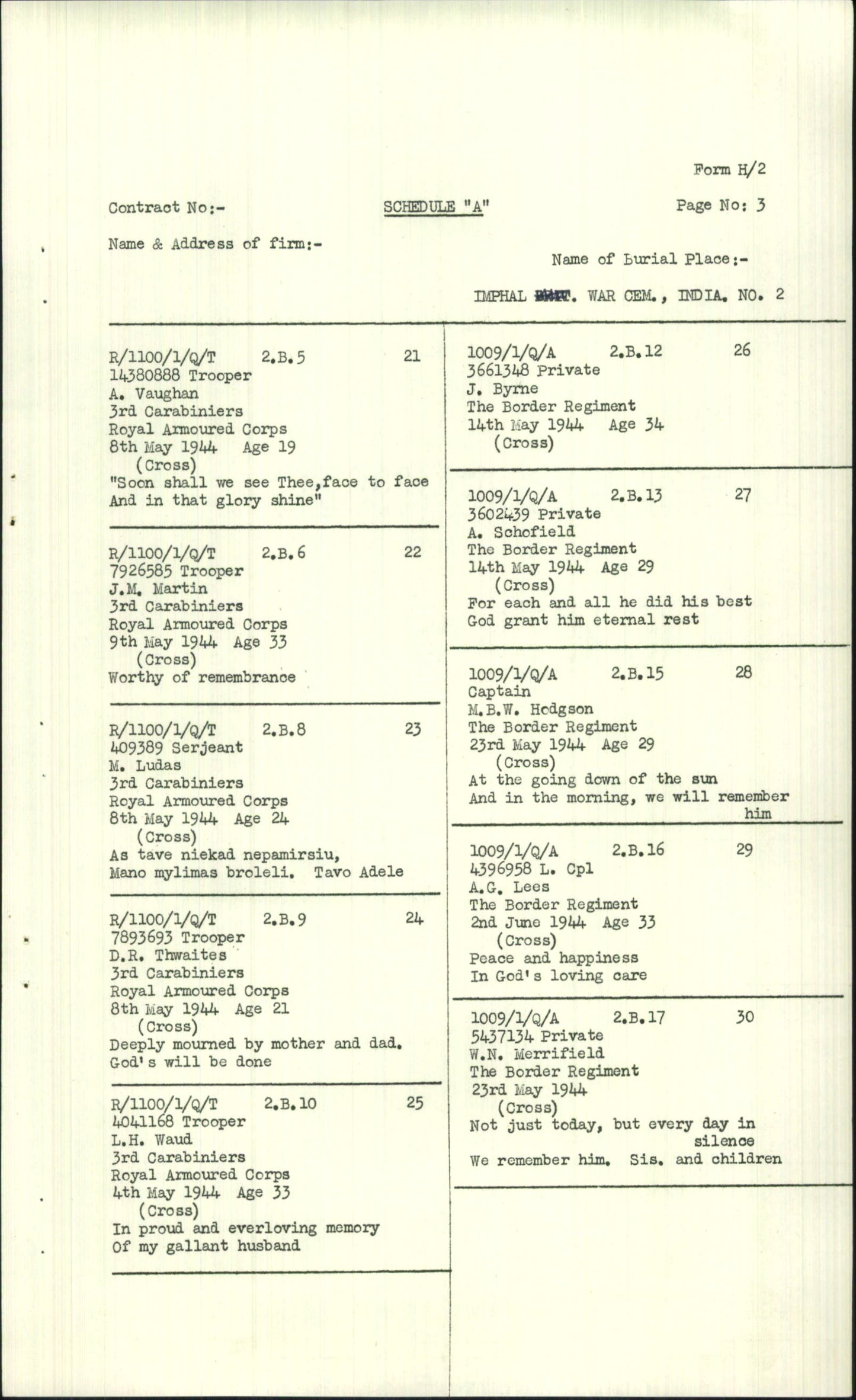
It was during this critical period of the campaign that Trooper Waud was killed in action on 4 May 1944, aged 33, in the Burma theatre. His death is recorded in the Army Roll of Honour, which confirms that he died in active service, serving with the 3rd Carabiniers, Royal Armoured Corps. The regiment was at this time heavily engaged in defensive and counter-offensive operations aimed at breaking the Japanese advance and securing the Imphal plain, and casualties were frequent and often severe.
He is commemorated by the Commonwealth War Graves Commission and is buried at Imphal War Cemetery, grave reference 2.B.10., a cemetery that holds many of those who fell during the fighting in this theatre. His headstone inscription, provided by his family, reads:
“IN PROUD AND EVERLOVING MEMORY OF MY GALLANT HUSBAND”
confirming both his marital status and the personal loss felt by his wife, Alice Elizabeth Isabel Waud of Bromley, Kent. At the time of medal issue, his widow’s address is recorded as 62 Morgan Road, Bromley, Kent, further anchoring the family’s post-war location.
His medal entitlement, as confirmed by his service record, consists of the 1939–45 Star, Burma Star, Defence Medal, and War Medal, reflecting operational service in the Burma campaign and wartime service more broadly.
Taken together, the records present a clear and compelling narrative: a North London-born soldier, working in war industry at the outbreak of conflict, who went on to serve as a Trooper in the Royal Armoured Corps, and who was killed in action during the Battle of Imphal in May 1944, one of the decisive engagements of the Burma campaign. His service with the 3rd Carabiniers, a regiment that played a crucial role in halting the Japanese advance into India, firmly places him among those who served in what has often been termed the “Forgotten Army”, fighting under some of the most demanding conditions of the Second World War.
PLEASE NOTE: All research will be sent to the buyer via email. I am unable to provide printed copies, as I do not have access to a printer.
AJMS Medals