


First World War 1914 Star “Mons” Trio – Private William Kinnear Brown, 2nd Bn. Argyll & Sutherland Highlanders – W.I.A. 1914
1914 Star – 7901 PTE. W. BROWN. 2/A.&S.HIGHRS
British War Medal – 7901 PTE. W. K. BROWN. A. & S. HIGHRS.
Victory Medal – 7901 PTE. W. K. BROWN. A. & S. HIGHRS.
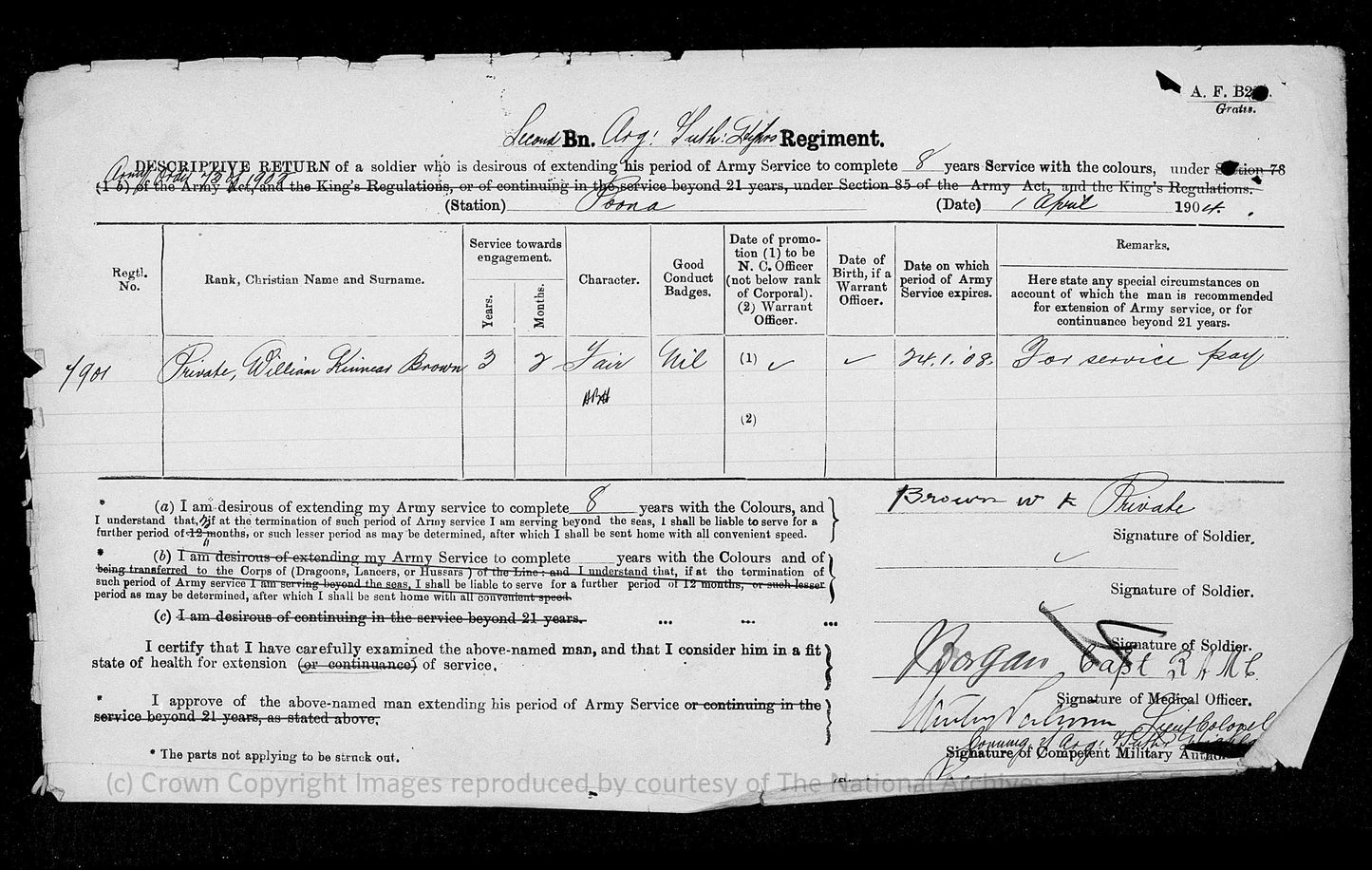
William Kinnear Brown was born in 1882 at Dundee, Scotland. Prior to joining the Regular Army he served in the 3rd Battalion, Royal Highlanders (Black Watch) Volunteer Battalion, from 14 December 1899 until 4 December 1900.
He enlisted into the Argyll & Sutherland Highlanders at Dundee on 25 January 1901, and joined the 2nd Battalion at Stirling on 28 January 1901. His attestation came at the height of the Boer War, when reinforcement drafts were urgently required for overseas service.
Brown began overseas service in India on 7 November 1901, remaining there until 28 December 1906. This was a lengthy and typical pre-war imperial posting, during which the battalion undertook garrison and internal security duties across British India. His conduct sheet during this period records numerous entries in the Defaulters’ Book, including repeated instances of drunkenness, breaking out of barracks, causing disturbances within barracks, appearing improperly dressed while in town at Calcutta, and concealing the fact that he was suffering from disease. These entries reflect a soldier who frequently came into conflict with military discipline, though he nevertheless remained in service and completed his Indian tour.
From 29 December 1906 until 1 March 1909, Brown served in South Africa, following the conclusion of the Boer War. Although active hostilities had ceased in 1902, the Army maintained substantial garrisons in the region during the post-war settlement period.
He transferred to the Army Reserve in March 1909, returning to civilian life, but subsequently re-engaged on 25 January 1913, indicating either economic necessity or renewed commitment to service as European tensions increased.
At the outbreak of the Great War in August 1914, the 2nd Battalion, Argyll & Sutherland Highlanders mobilised as part of the original British Expeditionary Force. Brown proceeded to France on 21 August 1914, placing him among the early reinforcements sent to sustain the hard-fighting Regular battalions during the opening campaigns.
On 8 December 1914, during the severe winter fighting of the first year of the war, he sustained a shrapnel wound to the head. He was evacuated the following day, returning home on 9 December 1914. The severity of the wound prevented further active service, and he was formally discharged on 12 May 1915 on account of wounds.
On discharge his address was recorded as 69 Hilltown, Dundee, bringing him back to the city where he had first enlisted over fourteen years earlier.
William Kinnear Brown’s military career spans pre-war Volunteer service, lengthy Regular Army postings in India and South Africa, and early service on the Western Front in 1914. Despite a disciplinary record marked by repeated infractions during his overseas garrison years, he served through the opening phase of the Great War and was ultimately discharged as a result of wounds sustained in action.
PLEASE NOTE: All research will be sent to the buyer via email. I am unable to provide printed copies, as I do not have access to a printer.
Visit my website for better prices on most of my stock.
AJMS Medals