


WW2 British Medal Group of 6 - Gunner Kenneth John Peace Thompson, Royal Artillery
WW2 Campaign Medals - unnamed as issued
Territorial Efficiency Medal - 5111919. GNR. K. J. THOMPSON. R.A.
Kenneth John Peace Thompson was born on 15th October 1921 at Nuneaton, Warwickshire, the son of John William Thompson and Frances Lillian Peace. He grew up in the Nuneaton area and was later residing at 64 Arbury Road, Stockingford, Nuneaton, the address recorded on his wartime medal claim card.
During the Second World War he served in the British Army with the Royal Artillery, holding the rank of Gunner and the service number 5111919. Records show that he was transferred from the 7th Battalion, The Royal Warwickshire Regiment on 27th February 1940, part of the large-scale wartime expansion and reorganisation of Britain’s anti-aircraft forces.
He subsequently served with the Royal Artillery Light Anti-Aircraft units, including 115 Light Anti-Aircraft Battery of the 115th Light Anti-Aircraft Regiment. This regiment had originally been an infantry battalion before being converted to the Royal Artillery on 1st January 1942, retraining on Bofors 40mm anti-aircraft guns used to defend troops and installations from low-flying enemy aircraft.
The regiment joined the 46th Infantry Division, a Territorial Army formation that had earlier served in France before being evacuated from Dunkirk. By August 1942 the division was assigned to First Army, preparing for the Allied landings in North Africa.
Following the Allied invasion of North Africa (Operation Torch) in November 1942, the 46th Division and its supporting units were progressively deployed into the Tunisian campaign. The division arrived in theatre in January 1943, moving into the front line shortly afterwards. During the campaign the division fought through difficult terrain and heavy Axis resistance, particularly during the fighting that followed the Battle of Kasserine Pass and the subsequent Axis offensive Operation Ochsenkopf.
Light Anti-Aircraft units such as the 115th LAA Regiment played an essential role protecting Allied formations from German dive-bombers and low-level attacks, particularly the feared Ju 87 Stuka aircraft. Their Bofors guns were frequently moved forward with the infantry despite extremely difficult conditions and constant air attacks. By the end of the Tunisian campaign in May 1943, the regiment had claimed 58 enemy aircraft destroyed, highlighting the intensity of its operations.
Following the North African victory, the 46th Division was later used for the Allied invasion of mainland Italy, landing during Operation Avalanche at Salerno on 9th September 1943. During the difficult fighting that followed, anti-aircraft units were heavily engaged defending the crowded invasion beaches and supply areas from Luftwaffe attacks while the infantry fought to secure the bridgehead.
The division subsequently advanced north through Italy, taking part in the fighting beyond Salerno and Naples, the crossing of the Volturno River, and later operations along the German defensive positions including the Winter Line. By early 1944, the division was engaged in difficult mountain fighting south of Monte Cassino, including operations around the Garigliano River.
Later in 1944 the division moved to the eastern side of Italy to participate in the offensive against the Gothic Line, one of the main German defensive positions across northern Italy. The fighting around Gemmano and the Rimini Line in September 1944 was particularly intense as Allied forces attempted to break through towards the Po Valley.
By late 1944 the Allied air forces had achieved almost complete air superiority, greatly reducing the need for large numbers of anti-aircraft units. As a result, the 115th Light Anti-Aircraft Regiment left the 46th Division on 8th November 1944 and was disbanded on 8th January 1945, with many of its personnel being transferred to other roles to help address the growing infantry manpower shortage.
For his wartime service Thompson qualified for the following campaign awards:
1939–45 Star
Africa Star
Italy Star
Defence Medal
War Medal 1939–45
These awards confirm service in the North African and Italian campaigns, two of the major theatres in which British anti-aircraft gunners were heavily engaged protecting advancing Allied forces.
Thompson was released from the Army on 11th May 1946 under Class “A” release, returning to civilian life in Warwickshire. His medal claim card confirms that he personally applied for his wartime medal entitlement and gives his address as 64 Arbury Road, Stockingford, Nuneaton.
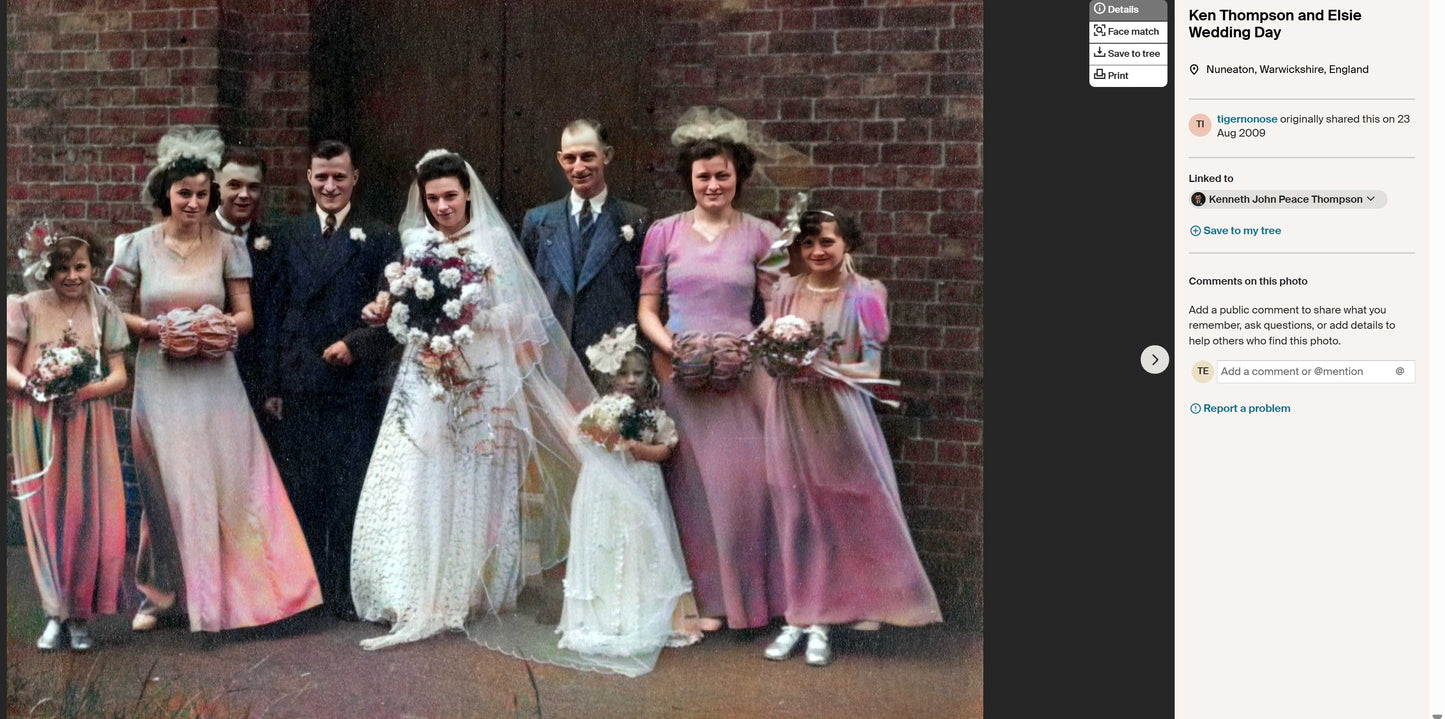
He married Elsie May Gilks in 1946, shortly after the end of the war. Kenneth John Peace Thompson died on 1st March 1996 at Nuneaton and Bedworth, Warwickshire, aged 74.
PLEASE NOTE: All research will be sent to the buyer via email. I am unable to provide printed copies, as I do not have access to a printer.
AJMS Medals